

Housing remains one of the fundamental rights for every citizen, yet thousands of rural families in Tamil Nadu continue to live in fragile hutments. To permanently transform the rural landscape, the Tamil Nadu Government officially introduced the Vetri Veedu Thittam 2026. Announced during the Revised Budget Estimates by Finance Minister Dr. N. Marie Wilson, this ambitious welfare project aims to eliminate kutcha huts by constructing permanent, concrete pucca homes across rural panchayats.
Furthermore, the state government has substantially increased the financial assistance to ₹5 lakh per house, ensuring that underprivileged families do not bear any extra financial burden during construction. If you want to understand the eligibility rules, application workflow, and essential guidelines, this detailed overview covers every aspect of the scheme

What is Vetri Veedu Thittam?
The Vetri Veedu Thittam (வெற்றி வீடு திட்டம்) is a flagship state housing initiative managed by the Rural Development and Panchayat Raj Department of Tamil Nadu. The initiative specifically targets low-income families residing in thatched, mud, or temporary kutcha dwellings across rural areas.
┌─────────────────────────────────────────────────────────────────────────┐
│                      VETRI VEEDU THITTAM 2026                           │
│     State Housing Scheme for a Hut-Free Rural Tamil Nadu                │
├─────────────────────────────────────────────────────────────────────────┤
│ • Unit Assistance : ₹5.00 Lakhs per house (Raised from ₹3.10 Lakhs)     │
│ • Initial Target  : 70,000 Pucca Concrete Houses                        │
│ • First-Year Budget: ₹3,500 Crores                                      │
│ • Implementing Body: Rural Development & Panchayat Raj Dept (TNRD)      │
└─────────────────────────────────────────────────────────────────────────┘
Historically, earlier housing projects fixed unit costs at lower levels, which forced poor beneficiaries to arrange extra funds for materials and labor. Consequently, many deserving households could not complete their homes or were excluded from benefiting altogether. By raising the sanction amount to ₹5 lakh, the government ensures that beneficiaries receive 100% financial backing to build safe, durable reinforced cement concrete (RCC) homes.
Key Highlights & Scheme Details (Copy-Paste Summary Table)
For quick reference, the core features and financial metrics of the Vetri Veedu Thittam are summarized in the table below:
| Feature / Metric | Details & Key Highlights |
| Scheme Name | Vetri Veedu Thittam (வெற்றி வீடு திட்டம்) |
| Nodal Department | Rural Development and Panchayat Raj Department, Govt of Tamil Nadu |
| Official Announcement Date | August 5, 2026 (Revised Budget Estimates) |
| Primary Objective | Complete replacement of rural kutcha huts with permanent pucca concrete houses |
| Subsidy Amount per Unit | ₹5,000,00 per house (Enhanced from ₹3,10,000) |
| First Phase Allocation | ₹3,500 Crore |
| First Phase Physical Target | 70,000 Concrete Houses |
| Target Population | Rural BPL households living in temporary huts/mud houses |
| Disbursement Mode | Direct Benefit Transfer (DBT) to beneficiary bank accounts in phased stages |
| Beneficiary Selection Method | Door-to-door physical survey followed by Gram Sabha verification |
| Official Portal | tnrd.tn.gov.in |

Major Objectives of the Vetri Veedu Scheme
The Tamil Nadu government established this housing project with clear socio-economic targets designed to uplift rural communities:
- Achieving a Hut-Free State: Eliminating unsafe thatched huts that are vulnerable to heavy rainfall, storms, and fire hazards.
- Financial Relief for the Poor: Increasing the unit subsidy to ₹5 lakh so low-income families do not need to take high-interest private loans to complete house construction.
- Transparent Target Selection: Eliminating duplicate entries, inclusion errors, and exclusion issues through fresh field audits and local Gram Sabha vetting.
- Resilient Rural Infrastructure: Standardizing disaster-resistant RCC roof construction across all village panchayats.
- Direct Financial Assistance: Transferring construction milestone funds directly into beneficiary bank accounts without middleman intervention.
Eligibility Criteria for Applicants
Applicants must satisfy specific state guidelines to qualify for the ₹5 lakh housing grant. The primary criteria include:
- Residential Location: The applicant must permanently reside within a rural village panchayat in Tamil Nadu.
- Housing Condition: The family must currently live in a kutcha hut (thatched roof, mud walls, or temporary shelter).
- Property Ownership: The beneficiary must own a plot of land with a valid land deed (Patta) or possess regularized land rights (poromboke regularized by the government).
- No Prior Housing Benefits: Applicants must not have previously availed of financial assistance under state or central housing schemes, such as Pradhan Mantri Awas Yojana (PMAY) or Kalaignar Kanavu Illam.
- No Concrete Ownership: Neither the applicant nor any household member can own a pucca concrete house anywhere in India.
- Bank Account Linking: The applicant must possess an active bank account linked with Aadhaar for Direct Benefit Transfer (DBT) funds.
Required Documents for Verification
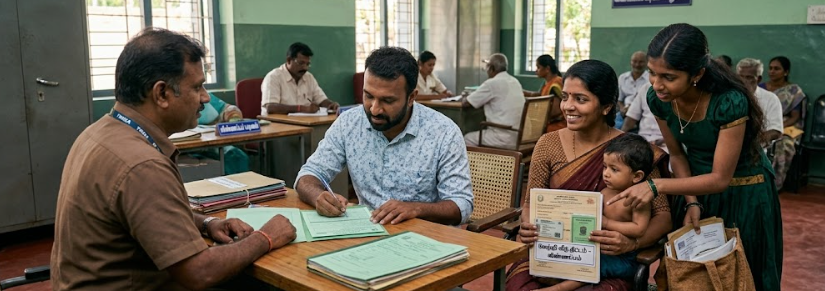
When field survey teams visit or when submitting details to local panchayat offices, ensure the following original documents and copies are readily available:
- Identity Proof: Aadhaar Card of the head of the family and household members.
- Residential Proof: Smart Ration Card (TNPDS) or Voter ID Card.
- Land Documents: Original Patta, Chitta, or land allotment document issued by the Revenue Department.
- Income Certificate: Recent income certificate issued by the competent Zonal Deputy Tahsildar.
- Bank Details: First page of the beneficiary’s bank passbook clearly showing account number and IFSC code.
- Passport-Sized Photographs: Recent photographs of the applicant.
- Existing House Photo: Photograph showing the current kutcha hut structure with the applicant present.
How to Apply & Selection Workflow
The Tamil Nadu government uses a proactive, survey-led identification mechanism to select eligible beneficiaries. As a result, individual citizens do not need to navigate complex online forms or pay fees to middlemen.
┌─────────────────────────────────────────────────────────────────────────┐
│                    SELECTION & DISBURSEMENT FLOWCHART                   │
├─────────────────────────────────────────────────────────────────────────┤
│ Step 1: Door-to-Door Survey by Rural Development Field Staff            │
│                            │                                            │
│ Step 2: Draft Priority List Preparation at Block/Panchayat Level        │
│                            │                                            │
│ Step 3: Public Vetting & Final Approval during Gram Sabha Meetings      │
│                            │                                            │
│ Step 4: Geo-Tagging of Site Location & Work Order Sanction              │
│                            │                                            │
│ Step 5: Phased Cash Disbursement via Direct Benefit Transfer (DBT)      │
└─────────────────────────────────────────────────────────────────────────┘
Step 1: Door-to-Door Field Survey
Field officers from the Rural Development and Panchayat Raj Department conduct on-site physical surveys across rural panchayats. They record GPS coordinates, assess house conditions, and compile a baseline database of eligible hut dwellers.
Step 2: Gram Sabha Vetting
After field teams complete their surveys, the draft beneficiary list goes before the local Gram Sabha. Community members review the names publicly to verify genuine eligibility and eliminate false claims.
Step 3: Geo-Tagging & Work Order Sanction
Once approved by the Gram Sabha, technical staff geo-tag the proposed construction site. Afterwards, the Block Development Officer (BDO) issues an official Work Order to the beneficiary.
Step 4: Construction & Milestone Cash Release
Construction happens under beneficiary supervision or with municipal support. Payments flow into bank accounts across distinct construction stages:
- Basement Level Inspection
- Lintel Level Completion
- Roofing Completion (RCC Roof)
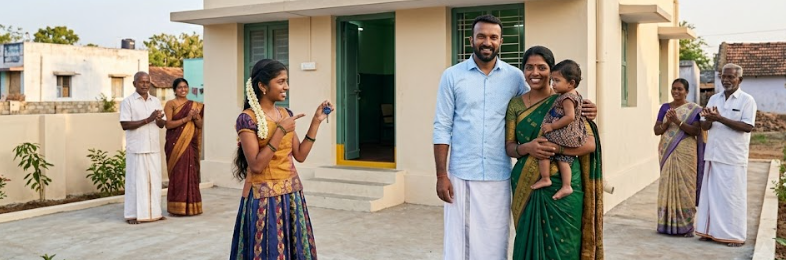
- Final Finishing & Toilet Construction
Important Dates & Implementation Timeline
| Event / Phase | Estimated Schedule |
| Budget Announcement | August 5, 2026 |
| Government Order (G.O.) Release | August / September 2026 |
| Door-to-Door Field Survey | September – October 2026 |
| Gram Sabha List Vetting | October / November 2026 |
| First Phase Work Order Issue | Late 2026 |
| First Phase Construction Target (70,000 Houses) | 2026 – 2027 |
Official Links & Portal Access
Beneficiaries can monitor scheme guidelines, circulars, and departmental updates through official Tamil Nadu Government channels:
- Rural Development & Panchayat Raj Department Portal: tnrd.tn.gov.in
- Tamil Nadu Government Main Portal: tn.gov.in
- Local Inquiries: Visit your local Village Panchayat Office or the Block Development Office (BDO) in your district.
Conclusion
The Vetri Veedu Thittam 2026 represents a major advancement in Tamil Nadu’s goal to eradicate rural poverty and ensure safe housing for every citizen. By raising the subsidy to ₹5 lakh per unit, the government directly addresses past financial bottlenecks and ensures that vulnerable rural families can construct high-quality pucca concrete homes. Furthermore, transparent Gram Sabha approvals and direct bank transfers guarantee that benefits reach genuine, deserving households without delay.
⚠️ Official Disclaimer
This article is published strictly for general educational and informational purposes. This platform is an independent news and informative portal and is not directly affiliated with the Government of Tamil Nadu or the Rural Development Department. The government charges zero application fees for this scheme. Citizens should avoid third-party agents or brokers and rely exclusively on official state portals (tnrd.tn.gov.in) or local Block Development Offices for official sanctions.
veedu
vetri veedu
வேலூர் மாவட்டம் தமிழ்நாடு குடியாத்தம் சீவூர் ஊராட்சி கல்லூரி கிராமத்தில் வசித்து வருகிறேன்
no house
சொந்த வீடு இல்லை. இருப்பதற்கு போதுமான இடம் இல்லை.
devi.rajan08@gmail.com