
Have you come across the news that the Tamil Nadu government is distributing newly constructed concrete houses to poor and needy families for just ₹85,000 to ₹1,00,000? In a country where owning a concrete roof over one’s head is a lifelong dream for millions, this news sounds almost too good to be true. Naturally, it has sparked widespread interest, curiosity, and questions across social media platforms and local communities.
But is the government truly selling entire individual houses or flats at such a nominal price? What is the hidden catch, who is eligible, and how can an ordinary citizen apply for this scheme? This extensive guide breaks down the absolute reality of the Tamil Nadu government housing scheme, explaining the mechanics of the project, eligibility standards, financial breakdown, and step-by-step application instructions.
The Reality Behind the Price: Total Cost vs. Beneficiary Contribution
To understand how a permanent, concrete flat can cost as little as ₹85,000, we need to demystify how public housing finance works in India.
The short answer is yes, eligible individuals can secure a flat by paying an upfront amount ranging between ₹85,000 and ₹1,00,000. However, this is not the total market value or construction cost of the house. Instead, this amount represents what the government calls the Beneficiary Contribution (பயனாளிகளின் பங்களிப்புத் தொகை).
The actual expenditure required to buy land, clear areas, source raw materials, and construct a multi-story residential building runs into several lakhs of rupees per unit. The reason a needy family only pays a tiny fraction of this cost is due to a massive, multi-tiered subsidy structure provided by both the Central Government and the State Government of Tamil Nadu.
How the Subsidy Works
The Tamil Nadu Urban Habitat Development Board (TNUHDB)—formerly widely known as the Tamil Nadu Slum Clearance Board (TNSCB)—works in tandem with central housing initiatives like the Pradhan Mantri Awas Yojana (PMAY-U).
When a housing project is launched, the total budgetary allocation per flat is heavily offset:
- Central Government Subsidy: Provides a flat financial grant per unit for urban poor housing.
- State Government Subsidy: The Tamil Nadu government absorbs the single largest portion of the remaining construction and land development expenditures.
- Beneficiary Share: The residual balance is left for the allottee to pay, which minimizes their financial burden while instilling a sense of ownership.
Regional Price Variations: Why Chennai Costs More
The financial guidelines explicitly declare that the beneficiary contribution is not uniform across the state. The exact amount an applicant has to pay depends primarily on the geographical location of the housing project.
The government has categorized these costs to ensure equity between metropolitan residents and those living in smaller towns:
- Districts Outside Chennai: For urban habitat projects constructed in districts outside of Chennai (such as Dindigul, Madurai, Coimbatore, Tiruppur, or Trichy), the beneficiary contribution is heavily subsidized and typically falls within the ₹85,000 to ₹1,00,000 range.
- Chennai Metropolitan Area: Due to significantly higher land acquisition values, complex logistical demands, and localized development costs in the capital city, the beneficiary share for tenements located within Chennai limits is usually fixed at ₹1,500,000 (1.5 Lakhs) or 10% of the project cost, whichever is lower.
Therefore, if you are looking to apply for a housing unit outside Chennai, you can realistically acquire your flat’s allotment by paying the targeted ₹85,000 to ₹1 Lakh sum.
Key Features of the TNUHDB Housing Scheme at a Glance
To make this complex scheme easy to understand, the critical details regarding pricing, sizes, amenities, and locations have been organized into the analytical reference table below:
| Feature/Parameter | Scheme Details & Project Specifications |
|---|---|
| Implementing Authority | Tamil Nadu Urban Habitat Development Board (TNUHDB) |
| Former Name of the Board | Tamil Nadu Slum Clearance Board (TNSCB) |
| Nature of Property | Multi-story concrete flats/tenements (அடுக்குமாடி குடியிருப்புகள்) |
| Beneficiary Share (Outside Chennai) | ₹85,000 to ₹1,00,000 (One-time payment or flexible terms) |
| Beneficiary Share (Inside Chennai) | Up to ₹1,50,000 (Depending on specific Government Orders) |
| Primary Target Audience | Slum dwellers, homeless families, and Economically Weaker Sections (EWS) |
| Standard Unit Layout | Typically includes a living room, a bedroom, a kitchen, and an attached bathroom |
| Core Amenities Provided | Concrete roads, continuous water supply, electricity connectivity, and streetlights |
| Official Online Portal | TNUHDB Official Website (https://www.tnuhdb.org.in) |
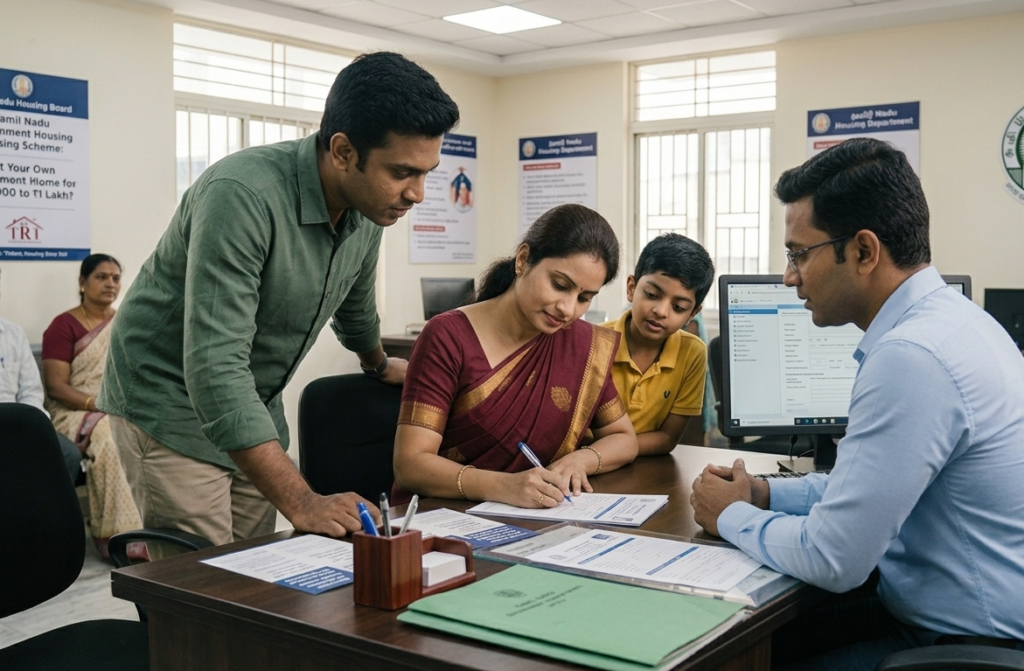
Strict Eligibility Criteria: Who Can Apply?
Because these houses are built using taxpayer-funded subsidies to eradicate urban poverty and slums, the Tamil Nadu government enforces strict eligibility cross-checks. Regular real estate investors or middle-income families cannot purchase these properties.
To qualify for an allotment under the TNUHDB scheme, an applicant must satisfy the following criteria:
1. Residential and Income Status
- Nativity: The primary applicant must be a permanent resident or native of Tamil Nadu.
- Income Ceiling: The family must fall under the Economically Weaker Section (EWS) category. Generally, this means the annual household income from all sources must not exceed ₹3,00,000 (₹3 Lakhs).
2. Property Ownership Status
- The “Pucca” House Rule: Neither the applicant nor any immediate member of their household (spouse, unmarried children) should own a permanent concrete (“pucca”) house anywhere across India.
- Target Environment: Preference is heavily directed toward individuals currently living in temporary huts, rented slums, makeshift roadside shelters, or areas highly prone to natural disasters (like riverbanks or low-lying flood zones).
3. Identity and Gender Prioritization
- Preference for Women: To encourage social security and women’s empowerment, the government prefers registering the house allotment in the name of the female head of the family.
- Age Limit: The main applicant must be at least 21 years of age.
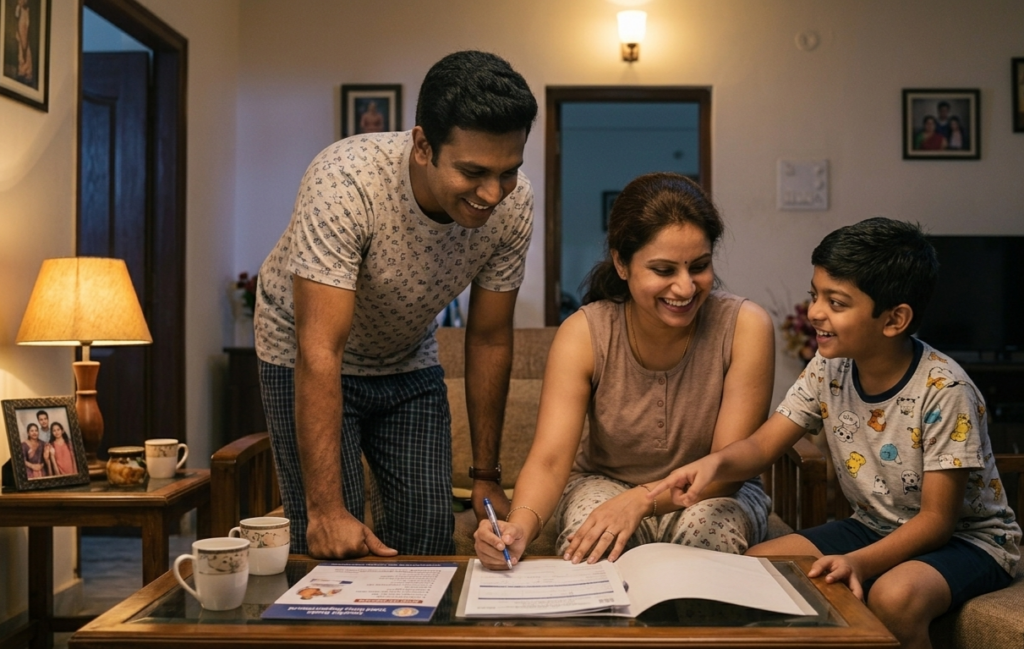
Mandatory Documentation Checklist
If you meet the eligibility rules, you will need to gather a comprehensive set of legal documents before submitting your request. Missing even a single file can lead to the immediate rejection of your allotment application. Ensure you have clear copies of:
- Proof of Identity: Aadhaar Card (mandatory for all family members), Voter ID, or Ration Card (Smart Family Card).
- Income Certificate: An official income certificate issued by the relevant local revenue authority (such as the Tahsildar).
- Nativity/Residential Certificate: Official proof verifying your residency duration in Tamil Nadu or specific urban slums.
- Bank Account Details: Passbook copy showing the account holder’s name, account number, and IFSC code (needed for tracking transactions or processing potential refunds).
- Passport Size Photographs: Recent passport-sized photos of the primary applicant and family members.
- Special Category Certificates: If applicable, community certificates, disability certificates, or destitute widow certificates to claim priority quotas.
Step-by-Step Application Process: How to Apply for a TNUHDB House
Securing a subsidized home involves a systematic procedure. The government periodically opens applications based on when specific structural projects near physical completion in various districts.
Step 1: Locating an Ongoing Project
Keep a close watch on local Tamil newspapers, district television broadcasts, or announcements posted at your local Corporation, Municipality, or Town Panchayat offices. Alternatively, navigate directly to the Official TNUHDB Namma Kudiyiruppu Portal to monitor active urban housing developments.
Step 2: Collecting the Application Form
When an active project open for allotment is announced in your district, visit the nearest TNUHDB Divisional Office or designated citizen service centers (like e-Sevai centers) to secure an official application form.
Step 3: Form Submission and Verification
Fill out the application form with accurate personal, income, and residential details. Attach your mandatory documentation checklist and hand it over to the designated housing board officer.
Once received, government field officials will physically visit your current residence to verify that you genuinely live in an urban slum or makeshift housing condition and that your income status matches your declaration.
Step 4: Allotment via Lottery System
Because the demand for low-cost houses drastically outnumbers the physical supply of constructed flats, the TNUHDB implements a transparent, randomized lottery system (குலுக்கல் முறை) to pick final beneficiaries. If your name is selected in the draw, you will receive an official Provisional Allotment Order.
Step 5: Paying the Contribution Amount
Upon receiving your allotment order, you will be instructed to deposit the specified beneficiary contribution (the ₹85,000 to ₹1,00,000 fee for districts outside Chennai) into the government’s authorized bank account. The board also coordinates with local banking institutions to help eligible low-income beneficiaries secure small, easy-to-repay personal or home loans if they cannot arrange the lump-sum payment immediately.
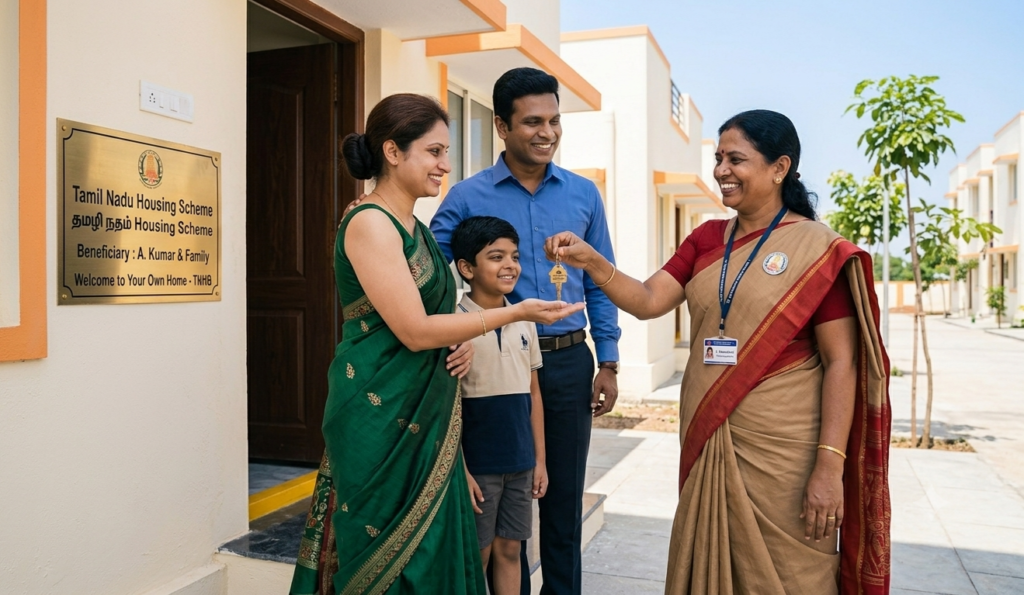
Important Terms, Restrictions, and Anti-Fraud Protections
Before applying or paying any money, every citizen must be fully aware of the strict legal clauses attached to these subsidized tenements:
🛑 Crucial Warnings for Applicants
- The Non-Transferable Clause: A flat allotted under this government scheme cannot be sold, leased, rented, or transferred to any third party for a mandatory lock-in period (typically 15 to 20 years, depending on specific board guidelines). The property is strictly meant for the residential use of the selected beneficiary family.
- Surprise Inspections: If the housing board discovers that an allottee has rented out their flat to someone else or is using it for commercial purposes, the government reserves the legal right to instantly cancel the allotment, seize the house, and evict the occupants without a refund.
- Beware of Middlemen and Scams: The selection process relies strictly on official verification and public lotteries. Do not trust brokers, local middlemen, or unauthorized agents who demand bribes or upfront cash promising a guaranteed house. Always make your payments directly to official board accounts and collect legal receipts.
Conclusion
The viral reports circulating online regarding the Tamil Nadu government providing concrete houses for ₹85,000 to ₹1 Lakh are completely valid, but they represent the beneficiary contribution share within a heavily subsidized system designed for the urban poor. For families struggling in sub-human living conditions or unsafe slums, this initiative functions as a monumental stepping stone toward long-term social security, health, and dignity.
If you or anyone you know qualifies under the Economically Weaker Sections (EWS) category, do not hesitate to track upcoming residential projects through your regional housing board offices. For direct online tracking, official announcements, digital receipts, and institutional verification, always refer strictly to the official government channel:
- Official Portal: Tamil Nadu Urban Habitat Development Board (TNUHDB)
Disclaimer
This article is compiled strictly for informational and educational purposes based on prevailing government orders, historical guidelines, and public policy announcements issued by the Tamil Nadu Urban Habitat Development Board (TNUHDB). Housing project availability, precise beneficiary contribution amounts, selection protocols, and eligibility rules are subject to localized changes, updates, or modifications by the Government of Tamil Nadu at any given time. Readers and prospective applicants are strongly advised to physically verify current scheme rules and project-specific costs with the official divisional offices of the TNUHDB or via their authenticated portal before undertaking any financial transactions or legal documentation.
I am aldredy registered in the portal but no response pls check the status
I’m from a lower-middle-class family. We don’t own any land or a house.
this scheme super
சிவகங்கை மாவட்டம்
காரைக்குடி தாலுகா
அழகாபுரி
“We are unable to pay our house rent due to our financial situation. That’s why we have applied for this scheme. None of us has a stable job, and our family is struggling to make ends meet.”
permanent address Villupuram but my childhood in chennai 2 age ipo 25 age ennum rental house la Iruka ennum enagala aoru house vanga mudiyala enku 3 brothers irukaga analum engala oru house kuda avanga mudiyala athanala tha chennai la gas bill and rental agreement thaa Iruku this my family
Hi sir/madam i’m salam i’m final year student of St’Thomas college of arts and science koyambedu.sir my family very lower family,low salary,my father is a labour ,my mom housewife only,my brother join 1st year student of new college my family very low background only. so please help me this TN government housing plan.
AM A SINGLE PARAENT, one boy child study in 3rd std HEALTH ISSUE ON VITILIGO,SOO NEED OWN HOUSE
I am poovar family
Hi sir i need home 🏡
my husband helath not ok
i want government house
45 years in i am rent house one house please
i need a government 85,000 scheme house. please more year iam living in rent house
housing vanukma sir
land purpose
enakku veedu ella athanala Venum
no land no house sir please help me
my husband auto driver 1 son 3year but ear problem so help me sir
housing vanum
housing vanum sir
good
please approve to give the house for my family எங்க அப்பா அம்மா ரோட்டுல கடை வச்சிருக்காங்க ரொம்ப குடும்ப கஷ்டம்
I really need this same from government because I am divorced nearly 6 years ago. I have a kid five years old. I’m Shankar parent. I am walking myself to help my family. That’s me and my son. I don’t have a Home. I am in a house. kindly help me to get Home.
Need help from government, I don’t have any Home. I am alone.
new home
new house
we want own house because we don’t have single own house we can’t pay rent so we want own house vijay anna please please please help
no home
my name is Kumar iam married two babys I stay the rent home my income 50% only my family runing very critical plz sir udersand my problem,🙏
iam staying rental house we don’t have own house
house 🏠
Need own house
Vijay anna please give me own house i don’t have own house i can’t pay rent to this house so please help me
i want to home
i need dream House
no veedu .poor family
My name gulnaz am house wife I work pink rapido bike every month paying my house rent is very difficult for me n husband
i have two kids and my salary full spend for kids school fees and regular commitments. I’m not able to save money and same time I don’t have house. still now I’m anywhere not invested or save money. in my family i only salary person depend on me 4 person mom,wife,2 kids. I need own house
என்னோட கணவருக்கு வலிப்பு நோய் இருப்பத்தாலும் அவரால் வேலைக்கு செல்ல கொஞ்சம் கஷ்டம் என்பதுலும் வீட்டில் இப்போதைக்கு சம்பாரிக்கும் ஒருவர் நான் மட்டும் தான் என்னோட சம்பளத்தில் அவருக்கு மருத்துவ செலவும் வாடகையும் தருவதற்கும் எனக்கும் கஷ்டமாக இருப்பதால் எனக்கு ஒரு பெண் குழந்தைந்தையும் இருப்பதால் இத்திட்டத்தில் வீடு இடைத்தால் எனக்கு மிகவும் பயனுள்ளதாக இருக்கும் இந்த விண்ணப்பதை தயவுசெய்து ஏற்றக்குமாறு கேட்டு கொள்கிறேன் 🙏🏻🙏🏻🙏🏻🙏🏻🙏🏻🙏🏻🙏🏻