

Dairy farming remains a foundational pillar of rural economies across southern India. However, many aspiring livestock owners encounter significant financial barriers when attempting to purchase high-yielding milch animals. Consequently, the Tamil Nadu Backward Classes Economic Development Corporation (TABCEDCO), operating directly under the state welfare framework, actively bridges this capital gap. Furthermore, this initiative collaborates closely with the Tamil Nadu Cooperative Milk Producers Federation (Aavin) to uplift rural households, empower women, and stabilize grassroots income streams. Thus, understanding the intricate structure of this program helps eligible citizens transform their economic standing through structured government-backed financial assistance.
In recent years, rural entrepreneurship has shifted from unorganized subsistence farming toward structured micro-enterprises. Nevertheless, access to institutional credit without predatory interest rates remains a challenge for marginalized communities. Therefore, state-sponsored credit schemes play an irreplaceable role in democratizing economic growth. By offering targeted loans with built-in subsidies and low interest ceilings, the government ensures that hardworking citizens can build sustainable assets. Ultimately, this article provides an exhaustive, step-by-step blueprint detailing eligibility, documentation, application procedures, and repayment models for the TABCEDCO dairy cow purchase initiative.

Detailed Breakdown: What is the TABCEDCO Dairy Cow Purchase Loan Scheme?
The Dairy Cow Purchase Loan Scheme is designed to provide targeted monetary assistance to individuals who wish to establish or expand micro-enterprises in cattle rearing. Specifically, an approved beneficiary can avail financial assistance of up to ₹1,20,000 to purchase a maximum of 2 dairy cows or buffaloes. In this arrangement, the administering corporation allocates precisely ₹60,000 per dairy animal to account for realistic market pricing and standard breed acquisition costs. Moreover, the program features an accessible annual interest rate of 7 percent coupled with a convenient repayment period spanning 3 years. As a result, rural entrepreneurs find it remarkably manageable to service monthly Equated Monthly Installments (EMIs) through steady daily or bi-weekly milk sales.
Unlike traditional commercial loans that carry high interest burdens and strict collateral requirements, this welfare-oriented financing model prioritizes social equity. Furthermore, the scheme requires minimal beneficiary contribution—typically restricted to just 5 percent of the total unit cost. Consequently, individuals who lack substantial personal savings can still step into commercial dairy farming. By establishing a direct link between the borrower and the local milk cooperative, the scheme guarantees an immediate market for the milk produced. Thus, cash flow management becomes seamless, ensuring that loan repayments do not choke household liquidity.
Quick Reference Matrix: Key Specifications and Financial Parameters
| Feature / Detail | Scheme Specification & Parameters |
| Scheme Official Name | TABCEDCO / Aavin Dairy Cow Purchase Loan Scheme |
| Executing Agency | Tamil Nadu Backward Classes Economic Development Corporation & Aavin |
| Maximum Financial Assistance | Up to ₹1,20,000 (Calculated at ₹60,000 per cow for up to 2 animals) |
| Beneficiary Margin Contribution | Nominal 5 percent of the total project valuation |
| Interest Rate Structure | Subsidized 7% per annum fixed/reducing balance |
| Repayment Tenure | 3 Years (Flexible monthly installments) |
| Primary Target Communities | Backward Classes (BC), Most Backward Classes (MBC), and Denotified Communities (DNC) |
| Official Web Portal | TABCEDCO Official Portal |

Comprehensive Eligibility Criteria for Applicants
Before initiating an application, prospective borrowers must ensure they satisfy all state-mandated criteria. First, the annual family income of applicants belonging to Backward Classes (BC), Most Backward Classes (MBC), or Denotified Communities (DNC) must remain strictly within ₹5 Lakhs. Second, the age of the primary applicant must fall between 18 and 60 years at the time of submission. Third, the individual must hold active membership with their local District Cooperative Milk Producers’ Union or primary milk cooperative society. In addition, state guidelines strictly restrict benefits to only one member per family to maximize coverage and prevent the concentration of state resources within single households.
Furthermore, applicants must possess adequate space or a dedicated cattle shed to house the animals safely. Access to a reliable water source and green fodder cultivation capability are evaluated during physical inspections by cooperative inspectors. Crucially, individuals who have previously defaulted on government-sponsored microloans or cooperative bank dues are automatically disqualified. Therefore, maintaining a clean financial track record is essential for securing final sanctioning from district committees.
Direct Copy-Paste Checklist: Mandatory Documents Required
Preparing your documentation file beforehand guarantees a frictionless verification process. Typically, district authorities require standard personal, financial, and residential proofs. Below is the complete mandatory checklist for your application file:
- Aadhaar Card for primary identity verification.
- PAN Card of the applicant.
- Community Certificate issued by a competent revenue authority (proving BC, MBC, or DNC status).
- Income Certificate confirming that annual family earnings remain below the ₹5 Lakh ceiling.
- Nativity or Residence Certificate verifying long-term state domicile.
- Smart Family Card (Ration Card) representing household members.
- Recent Passport-Size Photographs (minimum 4 copies).
- Proof of Cooperative Society Membership or an active registration slip from the local Aavin unit.
- Quotations or Project Profile detailing the intended breed, estimated cost per animal, and local veterinary certification.
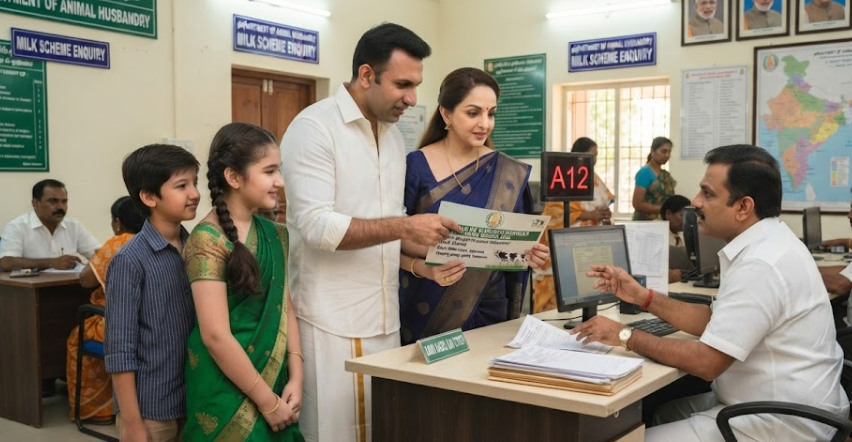
Step-by-Step Guide: How to Apply for the Scheme
Navigating the application process involves choosing between digital submission channels and traditional offline pathways. Fortunately, TABCEDCO provides an intuitive online portal alongside traditional district-level offices. Below are the exact operational steps required to successfully file your application:
Option 1: Digital Online Application Method
- Navigate directly to the official TABCEDCO web portal at tabcedco.tn.gov.in.
- Register using your active mobile number and personal email ID via the One-Time Registration portal.
- Log in securely using your newly generated credentials and select the Milch Animal Loan Scheme tab from the active schemes menu.
- Complete the digital application form meticulously, entering precise personal details, income figures, community classifications, and bank account particulars.
- Upload clear, scanned digital copies of all mandatory documents, including your community certificate, income proof, and Aadhaar card.
- Submit the digital application and safely record the system-generated reference number for subsequent tracking.
Option 2: Traditional Offline Application Method
- Download the official application form directly from the TABCEDCO portal or collect physical printed copies from your nearest district office.
- Visit your local District Backward Classes and Minorities Welfare Office, the Joint Registrar of Co-operative Societies, or your regional Aavin Milk Producer Cooperative Society.
- Fill out the physical form carefully using block letters, attaching self-attested photocopies of all required identity and income proofs.
- Submit the completed file directly to the administrative desk, ensuring you obtain an official acknowledgment receipt stamped by the receiving officer.
Important Timelines, Verification Phases, and Disbursement Workflow
Understanding the operational timeline helps applicants plan their cattle acquisition effectively. Following initial submission, the administrative verification workflow proceeds through several structured phases:
- Initial Screening (Days 1–7): District cooperative inspectors review submitted files for document completeness and income threshold compliance.
- Field Inspection (Days 8–20): Local officials visit the applicant’s residence to verify cattle shed readiness, water availability, and fodder arrangements.
- Sanction and Committee Approval (Days 21–30): The district-level selection committee reviews verified files and issues formal loan sanctions.
- Fund Disbursement: Approved funds are transferred directly through district central cooperative banks to facilitate immediate animal procurement.

Maximizing Dairy Farm Profitability: Operational Best Practices
Securing the ₹1.20 lakh loan is only the first step toward building a sustainable micro-enterprise. To ensure long-term success and effortless loan repayment, beneficiaries must adopt scientific farm management practices. First, selecting high-yielding indigenous or crossbred cattle (such as HF crossbreeds or Jersey mixes) directly influences daily milk output. Second, maintaining a balanced diet rich in green fodder, dry roughage, and mineral mixtures maximizes lactation cycles. Third, scheduling regular vaccinations and veterinary checkups prevents costly medical emergencies. By maintaining clean milking hygiene, farmers can command premium quality ratings at their local Aavin collection centers, thereby boosting net monthly revenue.
Conclusion
The Tamil Nadu dairy cow purchase scheme presents a remarkable opportunity for rural families seeking sustainable financial independence and economic resilience. By combining an attractive 7 percent interest rate with a substantial ₹1.20 lakh loan ceiling, the state successfully empowers micro-entrepreneurs to thrive in the competitive dairy sector. Therefore, eligible candidates belonging to backward communities should utilize this initiative, gather their documentation, and apply through authorized Aavin channels today to secure their financial future.
Disclaimer
This article is crafted solely for informational and educational purposes based on recent welfare announcements and cooperative guidelines in Tamil Nadu. Scheme rules, interest rates, eligibility thresholds, and fund allocations are subject to periodic modification by the state government and participating financial institutions. Readers are strongly advised to verify official updates directly through the TABCEDCO Official Website or local district cooperative offices before submitting any application.