
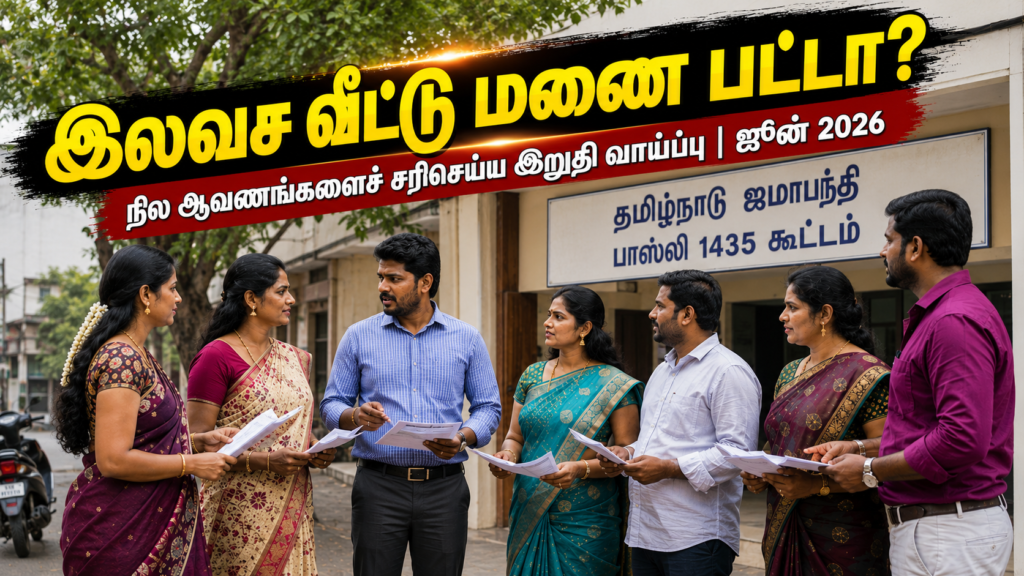
Managing land records, resolving property anomalies, and processing patta updates can often feel like an endless administrative maze. For land owners and agriculturalists across Tamil Nadu, the annual Jamabandi (Revenue Settlement of Accounts) acts as a streamlined window of opportunity to fix these exact issues.
The Government of Tamil Nadu has officially commenced the Jamabandi process for Fasli Year 1435. Running primarily through the latter half of June 2026, this intensive, decentralized program brings top revenue administrative officials directly to local Taluk and Tahsildar offices.
If you have been struggling with incorrect names on a Patta Chitta, mapping errors in the Field Measurement Book (FMB), or delays in receiving agricultural subsidies, this detailed guide provides everything you need to know about navigating the Jamabandi framework safely and efficiently.

Understanding Jamabandi: The History and Purpose
The term Jamabandi traces its origins to the Mughal administrative era, roughly translating to the systematic binding, balancing, and auditing of land records. Today, the modern Revenue Administration of Tamil Nadu preserves this practice as an absolute check-and-balance tool.
Unlike regular visits to a local village office, Jamabandi serves as a high-level audit where senior district officers—including District Collectors, District Revenue Officers (DRO), and Revenue Divisional Officers (RDO)—personally review the account ledgers maintained by Village Administrative Officers (VAOs) and Revenue Inspectors (RIs).
Why the Term “Fasli Year 1435”?
The revenue department operates on an agricultural calendar known as the Fasli Year.
- A standard Fasli year begins on July 1st and ends on June 30th of the subsequent calendar year.
- The session currently running in June 2026 corresponds strictly to Fasli 1435.
- During this period, every single transaction, yield account, crop inspection record (Adangal), and change in land ownership that transpired over the past year is verified face-to-face.
For citizens, this is not just an internal audit; it is an open-house grievance forum. It is the one time of the year where public petitions bypass typical bureaucratic gatekeeping, allowing land owners to receive direct orders from senior decision-makers.
Critical Metrics & Official Schedule at a Glance
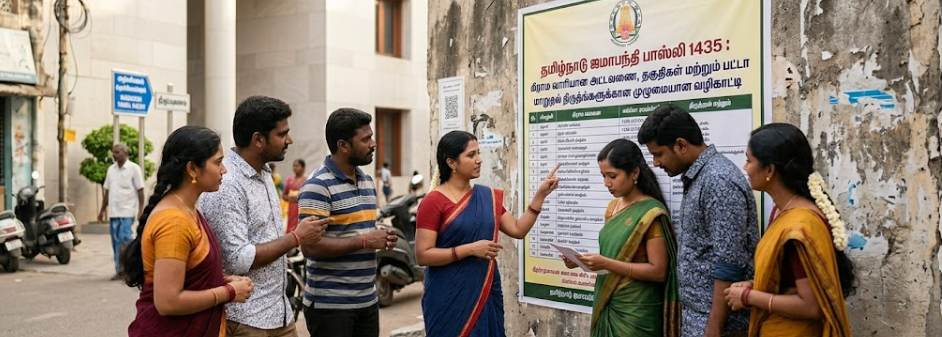
Because Jamabandi is decentralized, dates vary by local administrative jurisdiction. To keep up with your village’s specific audit day, refer to this consolidated master data overview.
Tamil Nadu Jamabandi 1435 Master Overview
| Parameter | Official Status / Operational Detail |
|---|---|
| Scheme Name | Revenue Settlement of Accounts (Jamabandi – ஜமாபந்தி) |
| Applicable State | Tamil Nadu, India |
| Target Revenue Year | Fasli 1435 (Covers transactions from July 2025 to June 2026) |
| Active Timeline | Mid-June 2026 to Late-June 2026 (Varies by local Taluk) |
| Primary Locations | All respective Taluk and Tahsildar Offices across 38 Districts |
| Daily Timing | Starts from 10:00 AM onwards (On all announced working days) |
| Core Objective | Public grievance redressal, land record correction, ledger auditing |
| Official Digital Portal | Tamil Nadu AnyTime Anywhere e-Services (Anyal) |
Regional Timeline Variations (June 2026)
The schedule is distinctly divided among various revenue divisions. Senior district authorities assign specific days to specific village clusters (Firkas).
- Dindigul District: The Revenue Settlement covers all 10 local Revenue Tahsildar offices, running actively from June 17, 2026, through June 25, 2026.
- Sivaganga & Tiruvannamalai Districts: Sessions are heavily concentrated between June 17, 2026, and June 24, 2026, with localized camps setting up inside regional offices like Polur and Arcot.
- Chennai District: Covering urban and semi-urban boundaries including Sholinganallur, Maduravoyal, Ambattur, Tiruvottiyur, Alandur, and Madhavaram, the core setup is planned from June 24, 2026, to June 25, 2026.
- Southern & Coastal Districts (Thoothukudi, Tiruvarur, Mayiladuthurai): Individual village rosters rolled out in rolling phases starting from early June, stretching across multiple weeks based on rural density.
To view the specific calendar day assigned to your village, input your district prefix into the official NIC platform architecture: https://[your-district-name].nic.in (e.g., https://dindigul.nic.in or https://chennai.nic.in). Look closely under the Press Release or Notices tab.
Eligibility Criteria for Submitting Petitions
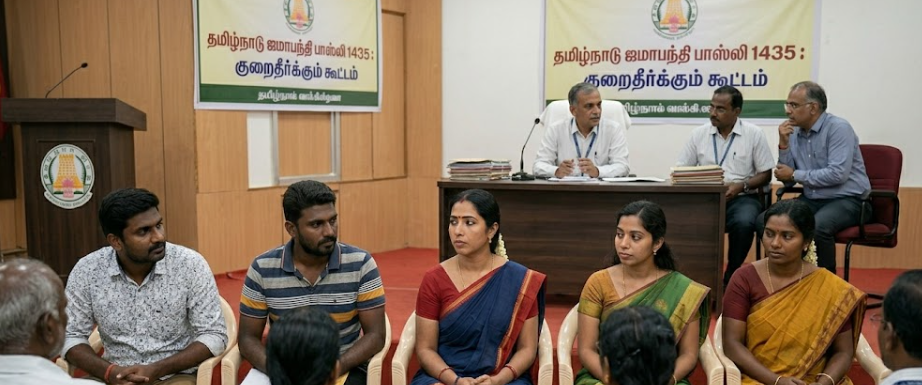
Unlike highly restrictive welfare schemes, Jamabandi camps operate an open-door policy for all citizens residing or holding property within the designated state boundaries.
- Land Owners & Title Holders: Any individual holding ancestral, purchased, or gifted property within Tamil Nadu facing discrepancies in their legal titles.
- Agriculturalists & Farmers: Farmers seeking accurate updating of their Adangal registers (crop records), registration of seasonal crop damages, or verification of agricultural lineage.
- Marginalized & Below Poverty Line (BPL) Residents: Individuals seeking government assistance regarding the distribution of free housing site pattas (Veetu Manai Patta).
- Senior Citizens & Vulnerable Individuals: Residents requiring immediate administrative intervention for state-sponsored social security welfare.
Permissible Grievances and Services Handled
You can submit petitions for a specific set of revenue issues during Jamabandi. Knowing exactly what falls under the jurisdiction of the Jamabandi Officer prevents your application from being redirected.
1. Patta Chitta Corrections and Modifications
- Patta Transfer (Patta Maratram): Transferring a land title after a sale, family partition, or inheritance.
- Sub-division (Utpirivu) Rectification: Adjusting boundaries when a single piece of land is split among multiple buyers or heirs.
- Typographical Corrections: Fixing spelling errors in names (both English and Tamil transliterations), father’s names, or incorrect survey numbers.
2. A-Register & FMB Mapping Corrections
- A-Register Adjustments: Fixing land classification errors (e.g., mistakenly labeling private property as Poramboke or public wasteland).
- Field Measurement Book (FMB) Errors: Resolving structural line drawing errors in village sketch maps that create overlapping boundaries with neighbors.
3. Government Welfare and Pension Alignment
- Social Security Pensions: Unreasonable delays or wrongful rejections regarding the Old Age Pension (OAP), Destitute Widow Pension, or Differently-Abled Pension schemes.
- Civil Supplies Integration: Addressing long-standing bottlenecks tied to smart ration card issuances or modifications.
Step-by-Step Guide: How to Apply and Submit Your Petition
To guarantee your petition is accepted and green-lit for fast processing, avoid generic summaries. Follow this structured roadmap to submit your application cleanly.
1.Verify Your Village’s Assigned Roster Date: Prerequisite Phase.
Check your district’s official website or visit your local Taluk office notice board. Identify the exact day the Jamabandi Officer is auditing your specific village. Do not present your petition on a day designated for a different village cluster.
2.Draft a Formal Grievance Petition: Documentation Phase.
Write a clear, concise petition in Tamil or English addressed directly to the Jamabandi Officer / [Designated Senior Revenue Official]. Explicitly state your Survey Number, Village name, Taluk name, and the exact nature of the correction or assistance required.
3.Compile Your Mandatory Supporting Documents: Verification Phase.
Collate all historical proofs required to back your claim. If it is a land correction, attach parent deeds, current online Patta prints, and identity records. Fasten them securely behind your primary petition form.
4.Present Your Case at the Taluk Camp: Submission Phase.
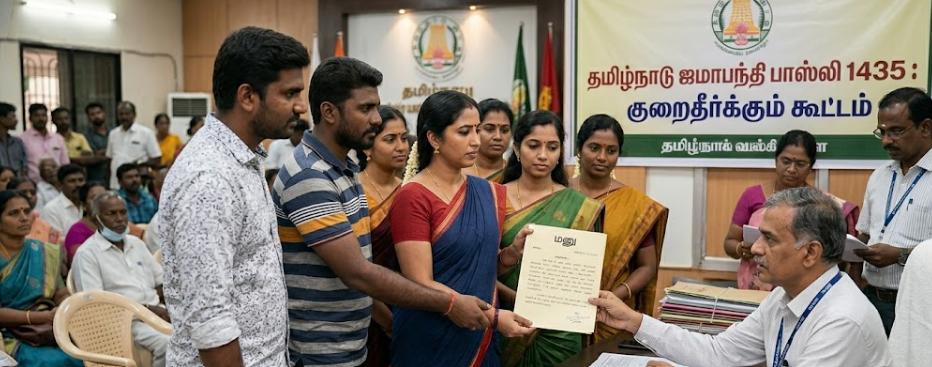
Arrive at the respective Tahsildar/Taluk office by 10:00 AM on your assigned date. Present your application package at the designated counter. The receiving officer will review it, log it into the tracking system, and issue an official acknowledgment slip.
Mandatory Documentation Checklist
Bringing an incomplete file will result in your application being deferred to standard, slow-moving administrative channels. Ensure you carry both the original documents and two sets of self-attested photocopies of the following records:
- Identity Proof: Aadhaar Card, Voter ID, or PAN Card.
- Address & Household Proof: Smart Ration Card (Family Card).
- Current Land Status Records: Latest downloadable computer Patta, Chitta, and FMB sketch sourced from the e-Services framework.
- Historical Land Ownership Proofs: Registered Sale Deeds, Parent Documents, Partition Deeds, or Gift Settlement Deeds.
- Legal Heir Certificate: Essential if you are seeking a title transfer following the demise of the original registered asset holder.
- Encumbrance Certificate (EC): A clean EC stretching back at least 15 to 30 years to verify the unencumbered lineage of the property.
Critical Official Reference Links
For digital verifications, downloading land maps, or monitoring the progress of revenue settlements, interact solely with official state infrastructure pipelines:
- Official Land Records Status Check: Tamil Nadu e-Services Patta/Chitta Portal
- Departmental Mainframe: Tamil Nadu Revenue and Disaster Management Department
- District Specific Dashboards: Access via
https://[your-district-name].nic.in
Conclusion
The Jamabandi Fasli 1435 camps offer an invaluable, transparent channel to clean up your property documentation under the direct oversight of senior administrative heads. Because these sessions conclude at the end of June 2026, acting swiftly within your village’s designated window is vital. Taking the time to compile clean paperwork and presenting it early in the daily session ensures your land records remain accurate, safe, and legally indisputable.
Editorial Disclaimer
Disclaimer: This article is prepared purely for informational and educational purposes based on official announcements, press releases, and gazette details issued by the Government of Tamil Nadu for Fasli 1435 (June 2026). While every effort is made to maintain absolute data accuracy, administrative schedules, rosters, and officer allocations are subject to real-time adjustments by regional district administrations. Readers are strongly advised to cross-verify specific dates with their local Village Administrative Officer (VAO) or official district portals before traveling to regional camps.
i want this scholarship for my family situation for my studies if you offer this scholarship it will help for my higher studies in medical field
i am Johnson Devaraj,
Madurai(west) – 62
i need this service to my area.
when will organize the Jamabandhi.
தமிழக அரசு இலவச வீடு வேண்டி
no home my dady 4 baby girl but no home plz new home , my native Trichy but still working Tirupur plz Tirupur new home.
mechine
nice
free mechine g
overnment