
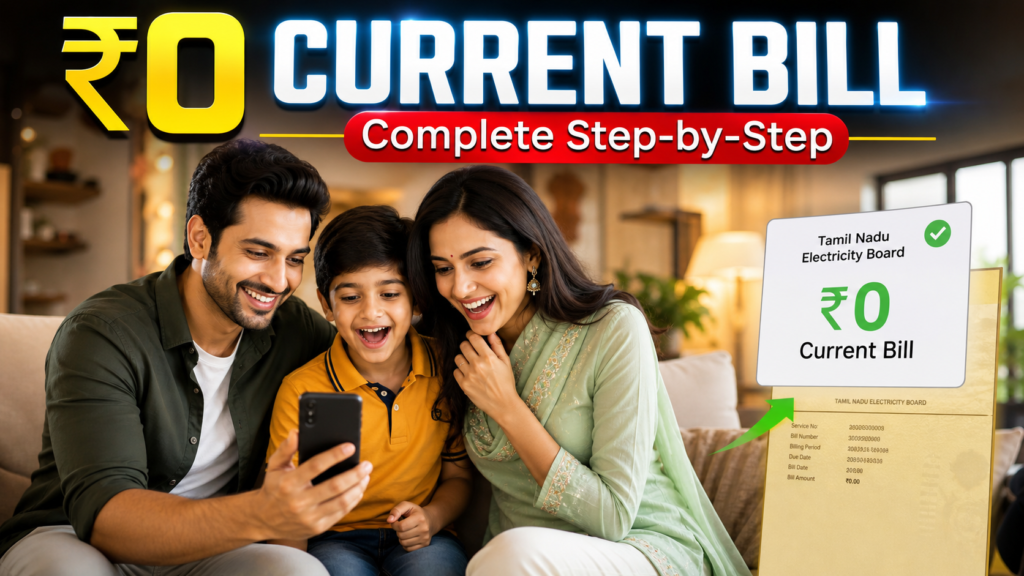
With the escalating costs of conventional electricity and erratic weather patterns across India, millions of households are turning their attention toward renewable energy solutions. Launched by the Government of India, the PM Surya Ghar: Muft Bijli Yojana (PMSG:MBY) stands out as one of the most ambitious and consumer-centric clean energy initiatives in the world.
The primary objective of this scheme is to provide up to 300 units of free electricity every month to 1 crore (10 million) households across the country. Over 7.7 lakh households in India have already reduced their electricity bills to zero, and the adoption rate continues to surge.
If you are an Indian homeowner planning to reduce your dependence on the grid, save thousands of rupees annually, and contribute to a greener planet, this comprehensive PMSGBY 2026 Update Guide provides everything you need to know about the latest subsidy rates, eligibility rules, and step-by-step online application process.
What is PM Surya Ghar Muft Bijli Yojana?
The PM Surya Ghar Muft Bijli Yojana is a national rooftop solar subsidy scheme managed by the Ministry of New and Renewable Energy (MNRE), Government of India. The program incentivizes homeowners to install Rooftop Solar (RTS) PV plants by offering direct financial assistance.
The benefits of the scheme are three-fold:
- Financial Relief: By utilizing solar energy during peak daylight hours, households drastically reduce their monthly electricity bills.
- Additional Income: Any excess solar power generated that is not consumed by the household is fed back into the regional grid via a net meter. This excess electricity is either credited in the subsequent power bills or paid out directly by the DISCOM (Power Distribution Company).
- Environmental Sustainability: Rooftop solar installations reduce reliance on coal-based power, driving down carbon emissions across India.
With the 2026 update, the government has further streamlined the net metering approvals, and state governments (such as Delhi, Tamil Nadu, and Uttar Pradesh) have introduced additional top-up subsidies to make transitioning to solar energy more accessible than ever.
Updated Subsidy Structure for 2026
Under the PM Surya Ghar Muft Bijli Yojana, the Central Financial Assistance (CFA) or subsidy is directly credited to the consumer’s bank account within 30 days of the commissioning of the system.
The subsidy amount depends on the capacity of the rooftop solar system installed. Below is the updated central subsidy breakdown:
Comprehensive Subsidy and Cost Estimation Table
| System Capacity | Suitable Monthly Power Consumption | Recommended Rooftop Area | Indicative Central Subsidy | Total Setup Cost (Approx.) | Effective Cost After Subsidy |
| 1 kW | 0 to 150 Units | 80 – 100 sq. ft. | ₹30,000 | ₹60,000 – ₹70,000 | ₹30,000 – ₹40,000 |
| 2 kW | 150 to 300 Units | 160 – 200 sq. ft. | ₹60,000 | ₹1,20,000 – ₹1,35,000 | ₹60,000 – ₹75,000 |
| 3 kW | 300+ Units | 250 – 300 sq. ft. | ₹78,000 | ₹1,65,000 – ₹1,85,000 | ₹87,000 – ₹1,07,000 |
| Above 3 kW | Heavy Residential Use | 350+ sq. ft. | Fixed at ₹78,000 | ₹2,20,000 – ₹3,50,000 | Varies depending on system size |
Important Note: For residential residential welfare associations (RWAs) or group housing societies (GHS), a subsidy of ₹18,000 per kW is available for common lighting or charging facilities, capped up to a maximum of 500 kW.

Eligibility Criteria for the Scheme
To avail of the generous subsidies provided under the PM Surya Ghar: Muft Bijli Yojana, an applicant must satisfy the following baseline eligibility criteria:
- Indian Citizenship: The applicant must be a citizen of India.
- Residential Property Ownership: The applicant must own the residential property where the rooftop solar system will be installed. Commercial complexes, agricultural setups, and industrial sites are not eligible for residential subsidies.
- Valid Electricity Connection: The household must possess an active domestic/residential electricity connection. The electricity bill must be in the name of the applicant.
- Adequate Rooftop Space: There must be sufficient shadow-free rooftop space available to install the solar panels safely. As a baseline, 1 kW requires roughly 80 to 100 square feet of area.
- Single-Time Subsidy Rule: The household must not have claimed any prior central or state subsidies for rooftop solar installations at the same address.
Required Documents for Online Application
Before starting the application on the official portal, it is important to collect the necessary documentation to ensure a hassle-free validation process:
- ஆதார் அட்டை of the applicant.
- Proof of Address (if different from the electricity bill).
- Latest Electricity Bill (must be within the last 6 months to establish consumer number and DISCOM details).
- Bank Account Details: A copy of your bank passbook or a clear photograph of a cancelled cheque. The bank account must be linked with the applicant’s Aadhaar to facilitate direct benefit transfer (DBT).
- Rooftop Ownership Proof or authorization certificate from the local body/RWA if applicable.
- Recent Passport Size Photograph of the primary applicant.

How to Apply Online: Step-by-Step Registration & Installation Guide
The Ministry of New and Renewable Energy has simplified the process down to a centralized online mechanism. The registration, technical feasibility checking, and subsidy processing are all managed via the National Portal.
Follow these exact steps to complete your online registration and get your rooftop solar system up and running:
Step 1: Registration on the National Portal
- Go to the official portal: pmsuryaghar.gov.in.
- Select the “Apply for Solar Rooftop” option.
- Enter your State, District, and select your local Electricity Distribution Company (DISCOM).
- Input your Consumer Account Number as shown on your latest utility bill.
- Enter your mobile number and authenticate it using the OTP sent to your phone.
- Verify your email ID and complete the profile setup by generating a secure password.
Step 2: Form Submission
- Log in using your registered mobile number and Consumer Number.
- Fill in the application form specifying your required solar rooftop capacity (e.g., 2 kW or 3 kW).
- Upload a scanned PDF or a clear photo of your latest electricity bill.
- Submit the application for Technical Feasibility Approval.
Step 3: DISCOM Approval & Feasibility Report
- Your local DISCOM will review the application. This process ensures your area’s local transformer has the technical capacity to feed extra electricity back into the grid.
- Once the DISCOM gives the technical feasibility approval on the portal, you will receive a notification via SMS and email.
Step 4: Installation by Empanelled Vendor
- You are required to get the solar system installed only through registered, empanelled solar vendors. You can view the full list of approved solar vendors on the National Portal.
- Discuss pricing, equipment models, and panel quality (e.g., Mono Perc, Bifacial panels) with the vendor.
- Ensure the solar panels comply with the Domestic Content Requirement (DCR) guidelines. Only Indian-manufactured solar cells and modules are eligible for the central subsidy.
Step 5: Submission of Installation Details
- Once the solar system is safely installed, your vendor will upload the installation details and photographs on the portal.
- You will verify these details to confirm the physical setup of the system.
Step 6: Net Meter Installation & Inspection
- Apply for a net meter through the same portal or your DISCOM’s local office.
- A technician from the DISCOM will visit your property to inspect the installation, install the bidirectional Net Meter, and switch the system on.
- After inspection, the DISCOM official will issue a Commissioning Certificate directly on the online portal.
Step 7: Claiming the Subsidy
- Log in to the PM Surya Ghar portal.
- Go to the subsidy claim section and submit your Bank Account details (including bank name, IFSC, and account number).
- Upload a cancelled cheque or a copy of your bank passbook.
- Once submitted, the National Portal triggers the direct bank transfer, and the subsidy is deposited into your bank account within 30 days of the commissioning date.

Official Government Website Links
For reliable and authentic information regarding updates, vendor listings, and loan options, only use official government websites:
- Official PM Surya Ghar Portal: pmsuryaghar.gov.in
- National Portal for Rooftop Solar: solarrooftop.pmsuryaghar.gov.in
- Ministry of New and Renewable Energy (MNRE): mnre.gov.in
- JanSamarth National Portal for Solar Loans: jansamarth.in/solar-roof-top-scheme
How Net Metering Works and Maximizes Your Savings
A common question among homeowners is: “How does the electricity bill reduce after setting up solar panels?” The answer lies in Net Metering.
A standard utility meter only tracks how much power you consume from the grid. A net meter tracks two metrics:
- Import: The amount of electricity your home pulls from the DISCOM grid during cloudy days, winter seasons, and at night.
- Export: The surplus solar energy generated by your panels during daylight hours that flows back into the grid.
At the end of the billing cycle, the DISCOM deducts your total export units from your total import units.
For instance:
- Your house consumed 400 units from the grid this month.
- Your 3 kW solar system generated and exported 350 units to the grid.
- Net Billing Amount: $400 \text{ Units} – 350 \text{ Units} = 50 \text{ Units}$.
Instead of paying for 400 units, you pay only for the net difference of 50 units. If your generation equals or exceeds your consumption, you only have to pay the basic fixed utility meter charges, effectively bringing your energy usage costs to zero.

Financial Support: Low-Interest Bank Loans
Recognizing that setting up a solar panel system involves an initial capital expenditure, the Indian government has tied up with various financial institutions to provide easy, collateral-free loans for residential solar.
Through the JanSamarth Portal, citizens can secure solar rooftop loans with the following benefits:
- Low Interest Rates: Financing is available at around 7% interest per annum, significantly lower than general personal loans.
- No Collateral Needed: The rooftop system itself acts as security for the bank.
- Flexible Tenure: Pay back your loan over a duration of up to 5 to 7 years using the savings from your reduced electricity bills.
- Simplified Processing: Top national lenders including State Bank of India (SBI), Punjab National Bank (PNB), Bank of Baroda, and Canara Bank offer instant processing directly via the portal.
Major Common Pitfalls to Avoid During Application
While the application process is digital and transparent, any small error can result in a delay or cancellation of the subsidy payout. Be mindful of the following pitfalls:
- Choosing Non-Empanelled Vendors: If you hire a private installer who is not registered on the official PM Surya Ghar portal, your installation will not receive approval, and you will forfeit the subsidy.
- Using Imported Modules: Under the Make in India initiative, subsidies are strictly limited to installations using DCR (Domestic Content Requirement) compliant solar modules. Ask your vendor for the DCR certificate before installation.
- Name Mismatch: The name on your electricity bill, your Aadhaar card, your PM Surya Ghar registration, and the bank account passbook must be identical. Even minor spelling variations can cause your direct benefit transfer (DBT) to fail.
- Poor Rooftop Survey: Ensure your rooftop does not have permanent obstructions (such as tall nearby buildings or trees) that cast continuous shadows. This lowers energy generation and reduces the system’s overall return on investment.
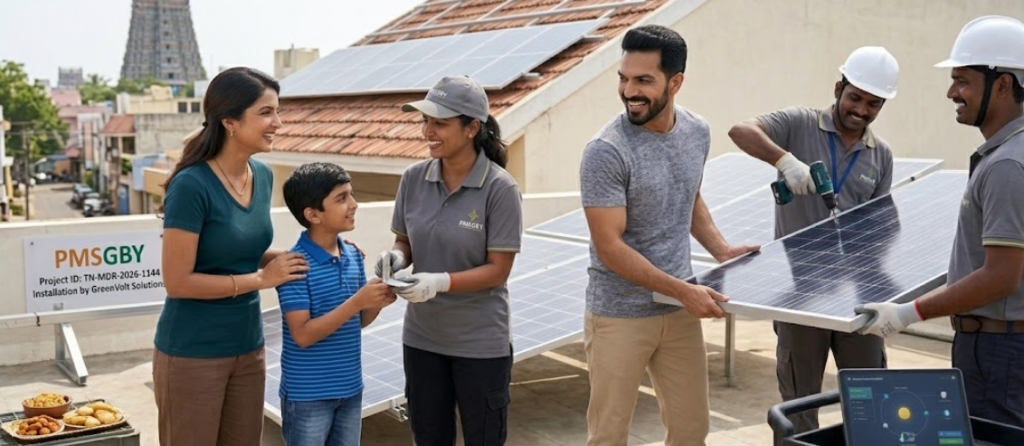
Summary of Key Takeaways
The Goal: Provide 300 free units of electricity per month to 1 crore households.
The Financial Support: Maximum central subsidy of up to ₹78,000 for a 3 kW system.
The Effective Cost: Installation costs for a 3 kW setup come down from ~₹1.80 lakh to around ₹1.02 lakh post-subsidy.
The Return on Investment: Payback period is usually between 3 to 4 years, after which the electricity produced is completely free for the rest of the solar panel’s life (25 years).
Where to Register: Only on the official national portal – pmsuryaghar.gov.in.
Frequently Asked Questions (FAQs)
1. Does the PM Surya Ghar scheme completely remove my electricity bill?
Yes, it can reduce your electricity usage charges to zero if your solar capacity matches your household consumption. However, you will still receive a nominal bill for the fixed or minimum administrative charges levied by your local DISCOM.
2. What happens if I live in a flat or apartment?
If you live in a multi-story building, you can apply for a shared solar rooftop system under the Resident Welfare Association (RWA) / Group Housing Society (GHS) category. A dedicated subsidy of ₹18,000 per kW is available for setting up common area systems.
3. How long do solar panels last after installation?
High-quality solar panels installed by registered vendors come with a standard performance warranty of 25 years. Inverters generally come with a 5 to 8-year warranty, meaning the system continues to save you money long after it has paid for itself.
4. Can I add more panels to my existing 1 kW system later?
Yes, you can upgrade your system capacity later by applying for a system enhancement on the National Portal. However, do note that your total cumulative subsidy will be capped at the official limits (maximum ₹78,000 for residential setups up to 3 kW).

முடிவுரை
அந்த PM Surya Ghar: Muft Bijli Yojana is a transformative step toward energy independence for Indian households. By leveraging the updated 2026 guidelines and the generous subsidy of up to ₹78,000, homeowners can effectively eliminate their monthly electricity expenses while contributing to India’s renewable energy goals. With the streamlined digital application process and low-interest financing options, there has never been a more financially viable time to transition to solar power. By following this guide, you can ensure a smooth installation process, secure your subsidy promptly, and enjoy the benefits of free, clean energy for the next 25 years.
பொறுப்புத்துறப்பு
Legal Disclaimer: This article is for informational purposes only. While every effort has been made to ensure the accuracy of the data according to the 2026 scheme updates, government policies, subsidy rates, and eligibility criteria are subject to change by the Ministry of New and Renewable Energy (MNRE) or respective state DISCOMs. Readers are advised to verify all details on the official national portal (pmsuryaghar.gov.in) before making financial commitments. The author and website are not affiliated with the government and do not guarantee the approval of subsidies.
heavy current bill
thank you
indha scheme vandhathukku romba thanks
switching machine