
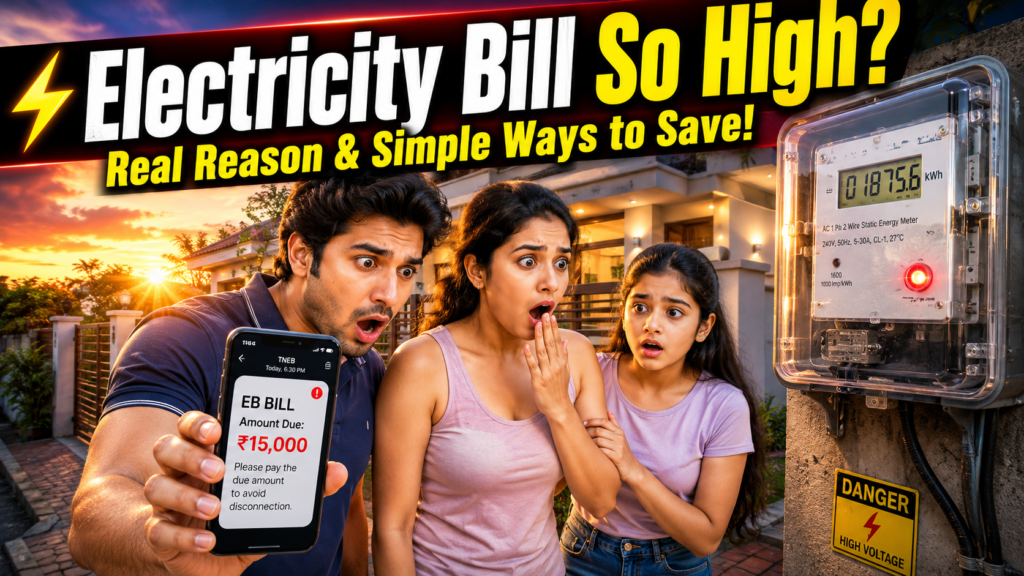
In recent months, electricity consumers across Tamil Nadu have voiced growing concerns regarding unexpectedly high electricity bills. Thousands of households report noticeable spikes in their bi-monthly power charges, leading to intense public discussion. Furthermore, many citizens wonder whether these increases stem from higher seasonal usage, recent tariff slab revisions, or errors in meter reading. Consequently, understanding how your electricity bill is calculated has become essential for every domestic consumer in the state.
Fortunately, the Tamil Nadu Power Distribution Corporation Limited (TNPDCL)—formerly operating under TANGEDCO/TNEB—provides an accessible online portal. Through this digital system, consumers can easily verify their meter readings, check exact units consumed, inspect tariff slabs, and review payment history without visiting a local section office.
Therefore, this comprehensive guide explains step-by-step how to check your TNPDCL electricity bill and consumed units online. In addition, it breaks down the state’s tariff slab structure, explains the 100 free units subsidy scheme, details the mandatory Aadhaar linking process, and provides practical methods to audit your bi-monthly bill.
Quick Reference Summary Table
The table below outlines key administrative details, official portals, eligibility criteria, and helpline contacts for quick reference and easy copy-pasting.
| Parameter | Details / Official Information |
| Managing Department | Tamil Nadu Power Distribution Corporation Limited (TNPDCL) / TANGEDCO |
| Primary Scheme Name | Tamil Nadu Free Electricity Subsidy Scheme (LT-IA Domestic Tariff) |
| Free Subsidy Quota | First 100 units free per month (200 units free per bi-monthly cycle for usage ≤500 units) |
| Eligibility Criteria | All domestic households registered with TNPDCL possessing a valid Aadhaar link |
| Billing Frequency | Bi-monthly (once every 2 months) |
| Official Bill Status Portal | TNPDCL Official Bill Status Page |
| Official Web Payment Portal | TNPDCL Online Payment Services |
| Mandatory Aadhaar Link Link | TANGEDCO Aadhaar Linking Portal |
| Customer Support / Helpline | 9498794987 (Minnagam 24/7 Consumer Care) |
Why Are Electricity Bills Rising in Tamil Nadu?
To understand your current bill, you must first recognize why total charges suddenly shift from one cycle to another. Many consumers assume that their rate per unit remains constant regardless of consumption. However, Tamil Nadu uses a telescopic tariff structure. Under this model, unit prices rise progressively as your total consumption enters higher billing slabs.
  0 - 100 Units   --->  FREE Subsidized Base Rate
101 - 400 Units   --->  Standard Tier 1 Slabs
401 - 500 Units   --->  Moderate Tier 1 Slabs
   > 500 Units    --->  TIER 2 CLIFF (Subsidy Drops + Higher Per-Unit Rates)
Several specific factors contribute to recent complaints regarding inflated bills:
- The 500-Unit Threshold Cliff: When bi-monthly consumption remains at 500 units or lower, households receive 200 free units and pay lower rates on remaining units. Conversely, as soon as consumption reaches 501 units, the household moves into Tier 2. As a result, the free subsidy drops to 100 units, and the excess units incur significantly higher per-unit charges.
- Seasonal Temperature Fluctuations: During warm summer months, household appliances like air conditioners, refrigerators, and water pumps operate continuously. Consequently, power consumption spikes rapidly, pushing households past the 500-unit threshold.
- Delayed Meter Reading Dates: Standard domestic billing occurs every 60 days. Nevertheless, if an assessor records readings on day 65 or 68 due to holidays or operational delays, those extra days of consumption can prematurely push a household into a higher slab.
- Appliance Upgrades: Adding new electronic devices without adjusting usage habits steadily increases overall power consumption over time.

Understanding TNPDCL Domestic Tariff Slabs (LT-IA)
Tamil Nadu Electricity Regulatory Commission (TNERC) governs the Low Tension Domestic (LT-IA) tariff structure. The state splits domestic consumers into two main tiers based on total bi-monthly usage.
Tier 1: Bi-Monthly Consumption Up to 500 Units
For households consuming 500 units or fewer during a two-month billing period, maximum state subsidies apply.
| Consumption Slab (Bi-Monthly) | Rate Per Unit (₹) | Subsidy Benefit |
| 1 to 200 Units | ₹0.00 | 100% Free (200 Units Subsidy) |
| 201 to 400 Units | ₹4.70 | Heavily Subsidized |
| 401 to 500 Units | ₹6.30 | Standard Subsidized |
Tier 2: Bi-Monthly Consumption Exceeding 500 Units
If your household crosses the 500-unit mark, even by a single unit, Tier 2 rules immediately apply. Consequently, your total bill increases noticeably.
| Consumption Slab (Bi-Monthly) | Rate Per Unit (₹) | Subsidy Benefit |
| 1 to 100 Units | ₹0.00 | 100 Free Units Only |
| 101 to 400 Units | ₹4.70 | Standard Subsidized |
| 401 to 500 Units | ₹6.30 | Base Rate |
| 501 to 600 Units | ₹8.40 | Unsubsidized Higher Slab |
| 601 to 800 Units | ₹9.45 | Unsubsidized Higher Slab |
| 801 to 1000 Units | ₹10.50 | Peak Slab Rate |
| Above 1000 Units | ₹11.55 | Maximum Slab Rate |
Moreover, additional minor charges appear on the bill, including fixed charges, state electricity tax, and Fuel Cost Adjustment (FCA) charges.
What is the 100 Free Units Scheme and Who is Eligible?
The Government of Tamil Nadu guarantees free electricity to domestic households to lessen financial burdens on citizens. Under this scheme, every domestic connection receives up to 100 free units per month (which equates to 200 free units per bi-monthly cycle for Tier 1 users).
Scheme Eligibility Criteria
- Domestic Consumers (LT-IA): All residential households holding an active TNPDCL domestic service connection qualify.
- Agricultural & Hut Connections: Specific agricultural pump sets and registered hut dwellings receive specialized 100% free supply schemes.
- Handloom & Powerloom Workers: Handloom weavers receive up to 200 free units bi-monthly, whereas powerloom units receive up to 750 free units bi-monthly.
- Mandatory Aadhaar Link: Consumers must link their 12-digit Aadhaar number with their electricity service connection number to retain the subsidy.
Step-by-Step Guide: How to Check Electricity Bill and Units Charged Online
Verifying your bill online takes only two minutes. Follow these straightforward steps to access your complete usage summary.
Step 1: Identify Your Service Connection Number
Before opening the portal, locate your unique Service Connection Number. You can find this number on your previous physical bill receipt, white meter card, or SMS alerts sent by TNPDCL.
The number typically follows a structured format: Region Code + Section Code + Service Number (e.g., 03-123-004-567).
Common region codes include:
01– Chennai North02– Chennai West03– Chennai South04– Chengalpattu05– Coimbatore06– Erode07– Madurai08– Trichy09– Tirunelveli10– Vellore
Step 2: Access the Official TNPDCL Bill Status Portal
Open your internet browser and navigate directly to the official TNPDCL Bill Status Portal.
Safety Warning: Always verify that you are visiting official
.gov.indomain addresses to keep your personal data secure.
Step 3: Input Required Connection Details
Once the page loads, you will see a simple verification form:
- Select your region from the drop-down menu or enter your full Service Connection Number.
- Type your Registered Mobile Number associated with the EB connection.
- Enter the security Captcha code displayed on the screen.
- Click the Submit பொத்தான்.
Step 4: Analyze Your Online Bill Summary
After clicking submit, the portal renders your official bill summary statement. This page highlights several vital pieces of data:
- Consumer Details: Name, address, and section office name.
- Previous Reading Date & Value: The meter reading recorded in the previous billing cycle.
- Current Reading Date & Value: The meter reading recorded during the current assessment.
- Total Consumed Units: Calculated automatically as $\text{Current Reading} – \text{Previous Reading}$.
- Billed Amount: The net payable amount after deducting eligible subsidies.
- Payment Due Date: The deadline to clear your bill before incurring disconnection warnings or late surcharges.

How to Link Aadhaar with Your TNPDCL Connection Online
Because Tamil Nadu mandates Aadhaar linkage for subsidy distribution, unlinked connections risk losing the 100 free units benefit. Fortunately, you can complete this process online easily.
Step-by-Step Aadhaar Linking Process
- Go to the TANGEDCO / TNPDCL Official Website.
- அதன் மீது கிளிக் செய்யவும் Aadhaar – Link Your Service Connection Number link listed under Online Services.
- Enter your Service Connection Number and registered mobile number.
- Verify the One-Time Password (OTP) sent to your mobile device.
- Select whether you are the Occupant, Owner, or Tenant.
- Enter your 12-digit Aadhaar card number.
- Enter the OTP sent to your Aadhaar-linked mobile number to complete authentication.
- Download the acknowledgment slip for future reference.
Mathematical Example: How Your Bill is Calculated
To understand how small shifts in unit consumption affect total cost, let us evaluate two distinct scenarios using the telescopic formula.
Scenario A: Consumption of 450 Units (Tier 1)
Since 450 units is less than 500 units, the household qualifies for Tier 1 subsidies.
- First 200 Units: 200 \times ₹0.00 = ₹0.00
- Next 200 Units (201 to 400): 200 \times ₹4.70 = ₹940.00
- Remaining 50 Units (401 to 450): 50 \times ₹6.30 = ₹315.00
- Total Base Energy Charge: ₹1,255.00
Scenario B: Consumption of 550 Units (Tier 2)
Because consumption exceeds 500 units, the household drops into Tier 2. The free quota reduces to 100 units, and higher per-unit rates apply.
- First 100 Units: 100 \times 0.00 = ₹0.00
- Next 300 Units (101 to 400): 300 \times ₹4.70 = ₹1,410.00
- Next 100 Units (401 to 500): 100 \times ₹6.30 = ₹630.00
- Remaining 50 Units (501 to 550): 50 \times ₹8.40 = ₹420.00
- Total Base Energy Charge: ₹2,460.00
Notice that consuming just 100 additional units causes the bill energy charge to jump from ₹1,255 to ₹2,460—an increase of ₹1,205. This comparison highlights why staying below 500 units bi-monthly saves substantial money.
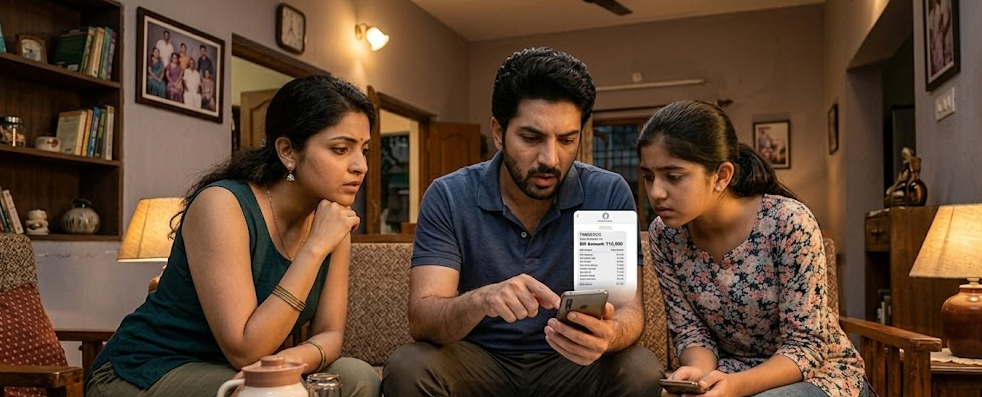
Practical Methods to Reduce Excessive Electricity Bills
If your recent electricity bill seems unusually high, implementing practical energy management techniques can quickly pull your usage back under critical thresholds.
- Monitor Air Conditioner Usage: Set air conditioners to 24°C or 25°C rather than 18°C. Running an AC at 24°C uses up to 24% less power while providing comfortable cooling.
- Track Bi-Monthly Meter Readings Manually: Take photo snapshots of your physical digital meter on day 30 and day 50. Doing so helps you predict your final reading before the official assessor arrives.
- Switch to 5-Star Inverter Appliances: Replace outdated fans and refrigerators with BLDC (Brushless Direct Current) fans and 5-Star rated inverter refrigerators, which consume up to 50% less energy.
- Identify Phantom Loads: Unplug chargers, set-top boxes, and microwave ovens when not in use. Standby power mode steadily consumes energy 24 hours a day.
- Consider Rooftop Solar Panels: Installing even a modest 1 kW rooftop solar system generates 120–140 units bi-monthly. This offset effectively brings your grid consumption back under the 500-unit threshold, unlocking Tier 1 subsidies once again.
Frequently Asked Questions (FAQs)
What should I do if my meter reading on the bill is higher than the actual physical meter reading?
If you suspect an incorrect meter reading entry, capture a clear photograph of your physical meter display showing the current kWh value. Next, contact the 24/7 Minnagam helpline at 9498794987 or register an official complaint through the TNPDCL web portal.
How can I register or update my mobile number in the TNPDCL database?
You can update your mobile number directly on the TNPDCL Mobile Update Page by providing your Service Connection Number, active mobile number, and identity verification.
Will I lose my 100 free units if I do not link my Aadhaar?
Yes. The Government of Tamil Nadu strictly mandates Aadhaar authentication to disburse electricity subsidies. Failure to link Aadhaar can result in the forfeiture of subsidised tariff benefits.
Is there a late fee for paying after the due date?
Yes. Paying after the due date attracts late payment surcharges and risks service disconnection. Paying promptly through official online channels ensures continuous service and avoids penalties.
முடிவுரை
Understanding how to check your electricity bill and consumed units on the TNPDCL website empowers you to take full control of your household energy budget. Recent concerns over rising electricity costs in Tamil Nadu stem largely from the sharp transition between Tier 1 and Tier 2 tariff slabs. By monitoring your meter readings regularly, maintaining an updated Aadhaar linkage, and adopting energy-efficient habits, you can keep your consumption within lower tariff slabs and avoid sudden bill spikes. Stay proactive, check your consumption online frequently, and utilize official digital portals for seamless billing management.
பொறுப்புத்துறப்பு
This article is intended strictly for informational and educational purposes. All product names, logos, trademarks, and service names mentioned belong to their respective owners, including the Tamil Nadu Power Distribution Corporation Limited (TNPDCL) and TANGEDCO. Tariff rates and policy guidelines reflect official orders issued by the Tamil Nadu Electricity Regulatory Commission (TNERC) and are subject to periodic administrative updates. Readers are encouraged to verify current rates directly on official government portals (tnebltd.gov.in / tnerc.gov.in)