

The administrative landscape of India is undergoing a massive, historic shift. On July 17, 2026, Tamil Nadu Chief Minister C. Joseph Vijay officially launched the State’s digital census operations by completing his very own online “Self-Enumeration” process at the Secretariat in Chennai.
This high-profile endorsement has sparked widespread conversations across social media platforms and neighborhoods alike. For the first time in the history of the Indian Census, the central government—in coordination with state machineries—is giving ordinary citizens the power to enter their own household information directly through a secure web portal and mobile application.
If you are wondering what this new digital phase means, why the government is pushing hard for public participation, or how exactly you can complete it from the comfort of your living room, you are in the right place. This comprehensive, SEO-optimized guide breaks down everything you need to know about the Census 2027 Self-Enumeration drive, ensuring your household stays fully informed, compliant, and ready.

What is Census Self-Enumeration?
To understand self-enumeration, we must first look at how the Indian Census traditionally operated. Historically, a physical army of government-appointed field workers (enumerators) would visit every house, apartment, and rural dwelling in the country. They would carry large paper booklets, sit down with the head of the family, and manually fill out dozens of questions regarding family size, literacy, housing structures, and basic amenities.
Self-Enumeration is the modern, digital evolution of this process. It is an optional, highly secure digital window opened by the government that allows citizens to securely log into an official platform and fill out their household’s Houselisting and Housing Census questionnaire on their own time.
Instead of waiting at home for a physical official to arrive or manually answering hours of questions on the doorstep, you become the data entry operator for your own family.
The Key Phases of the Census in Tamil Nadu
As announced by Governor Rajendra Vishwanath Arlekar and Chief Minister C. Joseph Vijay, the census operations are executing along a strict, highly organized timeline:
- Phase 1: Online Self-Enumeration (July 17, 2026 – July 31, 2026): A crucial 15-day window where the online system is unlocked for public access across the state. Citizens log on, fill out the forms, and lock down their data.
- Phase 2: Physical House Listing Operations (August 1, 2026 – August 30, 2026): Following the closure of the digital portal, trained field enumerators will begin their door-to-door physical verification drive across all neighborhoods.

Why Do We Have to Do It? The Crucial Importance of Accurate Data
As Chief Minister Vijay pointed out during his digital launch, “This is not just a mere headcount; the data you provide forms the very foundation for all public welfare schemes.”
Many citizens view the census as a dry statistical chore, but it directly impacts the quality of your daily life, your city’s infrastructure, and your family’s future access to state resources. Here is exactly why participating in this digital exercise is essential:
A. It Dictates the Allocation of Public Wealth and Resources
The central and state governments allocate hundreds of thousands of crores of rupees toward public welfare programs. Whether it is subsidized food rations, public housing allotments, clean drinking water pipelines, or electricity grid upgrades, the government allocates budgets based heavily on localized census metrics. If a specific neighborhood underreports its actual living population or financial stress markers, it risk receiving fewer resources over the next decade.
B. It Forms the Foundation for Infrastructure Planning
Have you ever wondered how municipal corporations decide where to build a new government hospital, set up a public school, layout a new metro line, or open a primary healthcare clinic? They look directly at census housing data. The density of homes, localized population clusters, and infrastructure deficits reported during this window tell urban planners exactly where expansion projects are critically needed.
C. Digital Accuracy Prevents Administrative Errors
Human error is an inevitable part of manual door-to-door data gathering. An enumerator might mishear a name, misspell an occupation, or incorrectly check a box on a paper form while standing out in the summer heat. By completing the self-enumeration online, you retain absolute control over your personal data. You ensure that spelling, birth years, education details, and employment statuses are entered with perfect accuracy.
D. Saving Time for Families and the State
Completing the digital questionnaire takes roughly 15 to 20 minutes. Once submitted, the system generates a unique digital receipt. When the physical enumerator knocks on your door in August, you do not need to sit down for an extended interview. You simply hand over the digital code, the official scans it, verifies the structural existence of the house, and the entire interaction finishes in under two minutes.

Step-by-Step Guide: How to Complete Self-Enumeration Online
Navigating government portals can sometimes feel overwhelming. However, the new digital census platform has been streamlined to remain highly accessible and user-friendly. To help you navigate the process without hitting administrative roadblocks, we have compiled a definitive, step-by-step walkthrough.
Pro-Tip before you begin: The official guidelines strongly recommend using a desktop computer or a laptop rather than a mobile phone. While the platform is fully mobile-responsive, the mapping tools and comprehensive drop-down options are significantly easier to see, manage, and verify on a larger computer screen.
Step 1: Access the Official Portal
Open your web browser and navigate directly to the secure central government web portal:
👉 Official Government Census Self-Enumeration Portal
Avoid navigating through unverified third-party search engine links or clicking on random WhatsApp forwards offering census registrations, as these could be phishing scams. Always ensure the URL ends securely with .gov.in before typing in personal information.
Step 2: Initial Household Registration
Once the homepage loads, you will be prompted to begin the registration process.
- Select your specific State or Union Territory (e.g., Tamil Nadu) from the drop-down menu.
- Solve the visual security Captcha displayed on the screen.
- Enter the full, legal name of the designated Head of Household.
- Provide an active mobile phone number belonging to an adult member of the household, along with an optional email address.
⚠️ Critical Rule: The system locks the name of the Head of Household immediately after you click register. It cannot be changed or edited online later. Additionally, a single mobile phone number can only be linked to one household registration; it cannot be reused to register secondary rental properties or extended family homes.
Step 3: Select Language and Verify OTP
Before proceeding to the core forms, the platform requires you to choose your preferred language interface. The portal supports English, Hindi, and 14 major regional languages, including Tamil.
Once your language is locked in, click on the Generate OTP button. The system will instantly beam a One-Time Password to your registered mobile phone. Enter the code to authenticate your digital session. Ensure you are in a location with a stable cellular network so the SMS delivery does not time out.
Step 4: Map Your Physical Residence Geographically
To accurately tie your household data to a specific municipal ward or village block, the platform utilizes an interactive GIS digital map layout.
- Manually input your basic geographical hierarchy: District, Sub-district, Village/Town, Locality, and a clear nearby local landmark.
- Entering your postal PIN code is optional but highly recommended to speed up the automated mapping.
- An interactive map screen will appear. Click and drag the digital pin marker to position it directly over the physical roof of your home.
This precise mapping allows the system to assign your form to the correct local Houselisting Block (HLB), enabling the local field team to track your digital form instantly during their August field checks.

Step 5: Fill the Houselisting and Housing Questionnaire
This is the core data entry stage of the application. The questionnaire is divided into clean, manageable thematic blocks. You will be asked clear questions regarding:
- The primary materials used to construct your home’s roof, walls, and flooring.
- The ownership status of the house (Owned, Rented, or otherwise).
- The total number of dwelling rooms occupied exclusively by your family unit.
- Access to vital drinking water sources, internal sanitation/toilet facilities, and primary cooking fuel types.
- General asset check-ins (such as possession of digital communication devices, two-wheelers, four-wheelers, etc.).
The system is configured to be linear: you must completely answer all required fields in your current section before the software permits you to click “Next” and advance to the subsequent section. However, you can freely use the navigation panel to jump back to previously completed pages to correct typos before final submission. The portal includes built-in tooltips, explanatory hover notes, and clear FAQs alongside complex questions to guide you smoothly.
Step 6: The Preview Screen and Draft Function
The portal includes a convenient auto-save mechanism. If you realize mid-way through data entry that you don’t know the exact spelling or details of an asset, you can safely save your application as a Draft and close the browser window. You can re-authenticate via mobile OTP later to pick up exactly where you left off, provided you complete it before the July 31 closing date.
Once the entire form is complete, you will land on a comprehensive Preview Screen. Read through every name, age, address detail, and asset checkbox with strict attention to detail.
Step 7: Final Submission and SE ID Generation
Once you are perfectly satisfied with the accuracy of the data, click on the Final Submit பொத்தான்.
🔴 Point of No Return: Clicking Final Submit securely encrypts and locks your file. The data is immediately transferred to the central census database, and you will lose all ability to edit or modify the form online. Any future corrections can only be made manually when the field enumerator visits your physical property in August.
Upon a successful transmission, the portal will generate a unique, 11-digit Self-Enumeration ID (SE ID), which systematically begins with the absolute identifier letter “H“. This number will immediately flash on your screen, and an automated copy will be dispatched to your phone via SMS and to your email address. Print this confirmation screen or write down the SE ID clearly in a safe, accessible home folder.

Key Rules, Deadlines, and What Happens Next
To help you easily scan and digest the vital parameters governing this national project, we have organized the core rules, deadlines, and procedural workflows into a clear comparative breakdown.
Essential Timelines and Platform Metrics
| Parameter | Official Detail / System Metric |
|---|---|
| Self-Enumeration Portal Status | Active and open right now |
| Online Window Deadline | Closes permanently on July 31, 2026 |
| Physical House-to-House Phase | Runs from August 1 to August 30, 2026 |
| Official Online Web Portal | https://se.census.gov.in |
| Language Support Scope | English, Hindi, and 14 distinct regional languages |
| Average Completion Time | Approximately 15 to 20 minutes per household form |
| Final Digital Receipt Format | Unique 11-digit alphanumeric SE ID beginning with “H” |
| Administrative Omissions | Certain data points like Building Number and Census House Number are left blank online; they are filled out exclusively by the visiting official. |
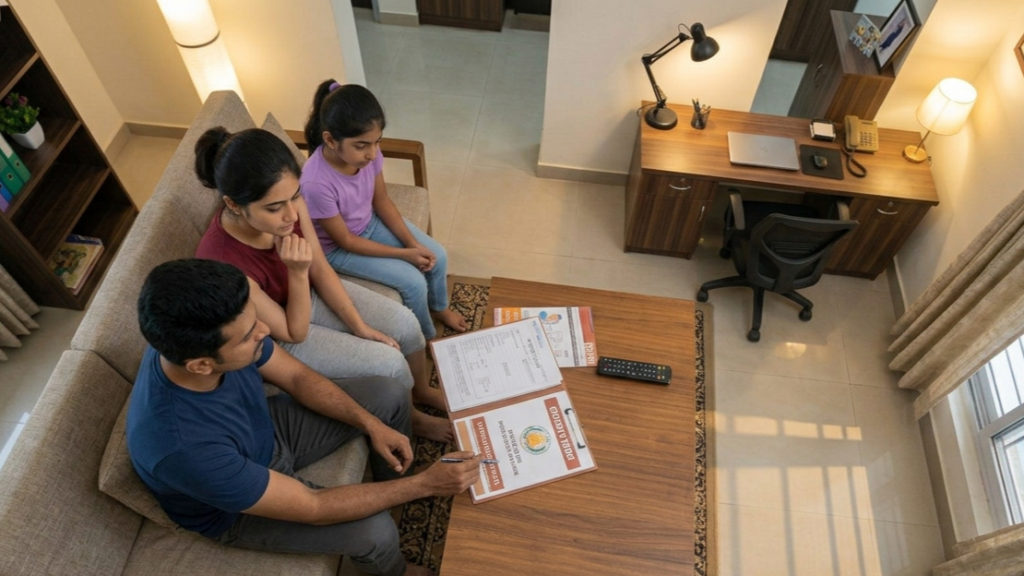
What to Expect During the August Field Visit
Many citizens mistakenly assume that completing the online self-enumeration exempts their home from the physical census visit entirely. This is incorrect. The physical field drive is still mandatory, but your digital participation alters the nature of the interaction:
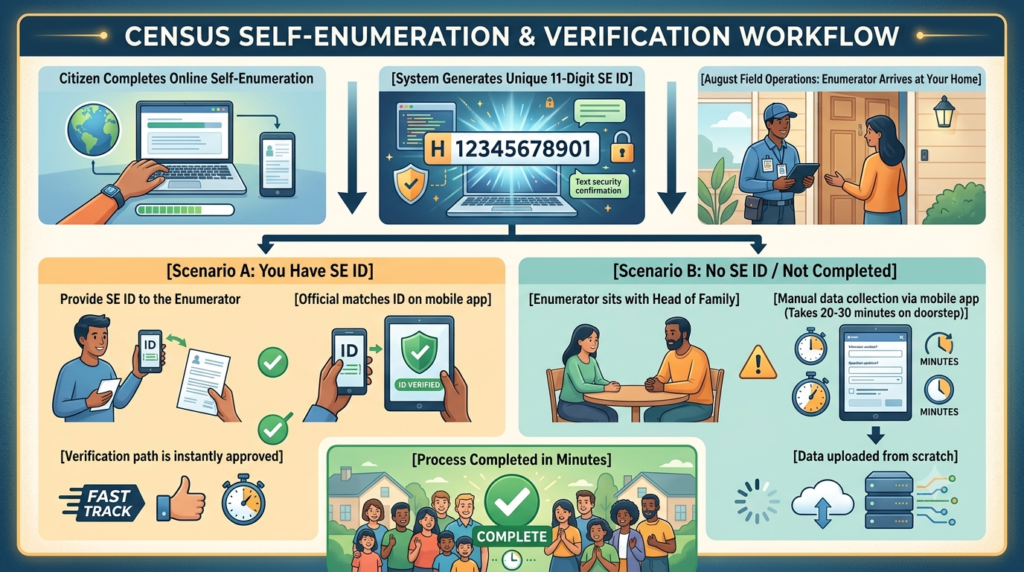
- If you have your SE ID ready: When the official knocks on your door, you present the 11-digit code. The official inputs this code into their government-issued mobile device application. If the record matches, the app pulls up your pre-filled framework. The official quickly confirms the physical structure of the residence, signs off on the data, and leaves within minutes.
- If you missed the online window: The enumerator will have to execute the complete houselisting interview live on your doorstep. They will manually ask every single question, fill out the answers on their handheld device from scratch, and upload it. This extended interaction can take a significant amount of your time.
Privacy, Safety, and Data Security Controls
In an era defined by increasing digital connectivity, data privacy concerns are completely natural. Providing deep, granular details about your household structure, assets, and geographic parameters to an online repository requires a high degree of trust.
The Census Organization of India has implemented robust, multi-layered structural protections to secure citizen details:
Absolute Legal Confidentiality
Under the stringent statutory mandates of the Census Act of 1948, all raw individual records collected during the national census operations are classified as strictly confidential by law. Chief Minister Vijay re-emphasized this fact explicitly during his launch address, assuring the public that their personal parameters are entirely shielded.
Protection Against Third-Party Access
By law, census data can never be accessed by private corporations, commercial entities, or third-party marketing firms. Furthermore, individual census records are fully protected against judicial scrutiny; they are legally inadmissible as evidence in a court of law.
How the Data is Utilized
The government does not publish individual profiles. Instead, the raw household details are run through advanced statistical aggregation algorithms. The systems distill millions of individual inputs into massive, anonymized regional data chunks (e.g., “42% of households in District X have shifted from LPG to alternate fuel sources”). These high-level statistical percentages are the only insights made public or utilized for national development frameworks.

முடிவுரை
The evolution of the Indian Census into a digital-first ecosystem marks a massive milestone for citizen-centric governance. By introducing the secure Self-Enumeration portal, the state has actively eliminated the bureaucratic friction of manual paperwork, minimized administrative data errors, and respected the valuable time of working families.
Taking 15 minutes out of your day before the July 31, 2026 deadline to log onto the portal is a simple, modern act of civic responsibility. It ensures your family is accurately counted, your neighborhood is properly represented, and your community receives its fair share of future public infrastructure and welfare development.
Follow the step-by-step checklist outlined above, navigate to the official portal at se.census.gov.in, secure your 11-digit SE ID, and help pave the way toward a more efficient, digitally empowered nation.
பொறுப்புத்துறப்பு
This article is prepared exclusively for public educational, informational, and general awareness purposes. While every effort has been made to ensure the highest degree of structural accuracy and fidelity to current administrative announcements, operational schedules, platform behaviors, and deadlines are subject to direct adjustments or extensions by the Office of the Registrar General & Census Commissioner of India, or the respective State Government authorities. Always cross-reference operational queries and verify technical system changes by visiting the official, authenticated government web infrastructure at india.gov.in or se.census.gov.in.
hi
Street road sari illa yarum olungu panna matikaka .Nalla road potu tharanum two wheelers la pona skita ahitumonu oru payama eruku .Thoothukudi,vannar second Street , please action annaa
How to apply the self enurimetion
Census