
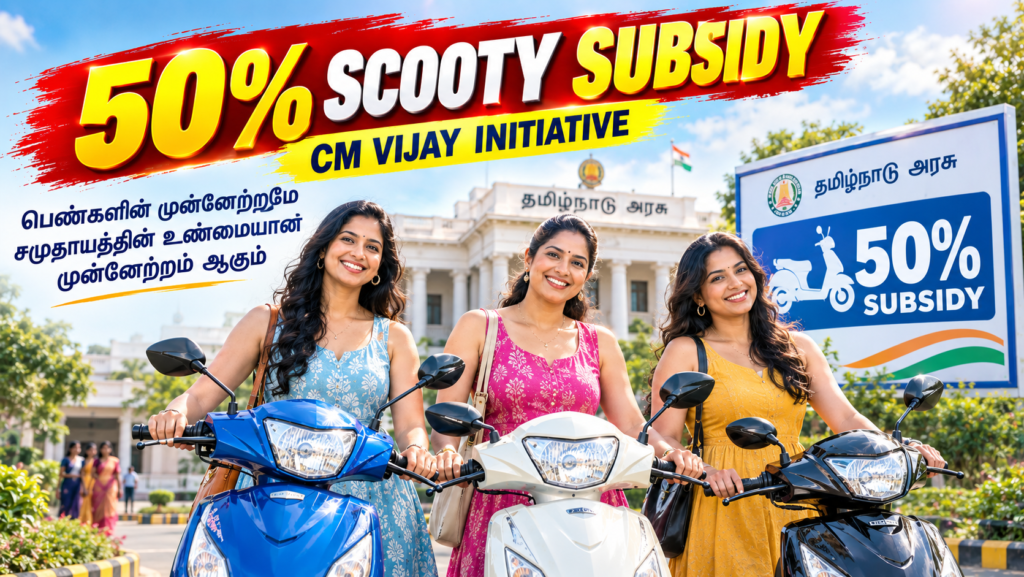
Empowerment begins with mobility. For millions of working women, daily commuting presents a major hurdle to financial independence. Public transportation can be unreliable, crowded, or unsafe during late hours. Recognizing this crucial need, state governments across India have introduced targeted financial assistance programs. These initiatives provide up to a 50% subsidy on scooties and two-wheelers to help women commute efficiently to their workplaces, self-help groups, and small business ventures.
However, navigating government portals, understanding exact eligibility terms, and tracking active application dates often feels overwhelming. This comprehensive guide breaks down every detail of the 50% Scooty Subsidy Scheme for Women, including state-wise variations, step-by-step application procedures, required documentation, and direct official links.

What is the 50% Women’s Scooty Subsidy Scheme?
The 50% Scooty Subsidy Scheme is a government welfare initiative designed to enhance financial independence among women by making personal transport affordable. While famously pioneered by Tamil Nadu as the Amma Two-Wheeler Scheme, similar mobility subsidies have been adapted across multiple regions, including Puducherry (Mudhalvarin Pudhumai Penn e-Scooter Scheme) and Kerala (She Scooter Scheme).
Under this framework, eligible beneficiaries receive a direct financial grant covering 50% of the vehicle’s purchase cost, subject to a fixed upper ceiling (typically ₹25,000 to ₹1,000,000 depending on the specific state policy and whether the vehicle is petrol-driven or electric).
Key Highlights at a Glance
| Feature | Details & Specifications |
| Primary Beneficiaries | Working women, self-employed females, daily wage earners, and students |
| Subsidy Percentage | Up to 50% of total vehicle cost (up to 75% for specific SC/ST schemes) |
| Maximum Subsidy Cap | ₹25,000 (Standard) up to ₹1,000,000 (Special e-Scooter initiatives) |
| Vehicle Specifications | Gearless/Auto-geared up to 125cc OR government-approved electric scooters |
| Disbursement Mode | Direct Benefit Transfer (DBT) into the beneficiary’s bank account |
| Family Restriction | Strictly limited to one woman per household |
State-Wise Scheme Breakdown & Current Operational Status
Different states manage their mobility subsidies independently. Furthermore, policies are updated periodically based on state budgets and political transitions.
1. Tamil Nadu: Amma Two-Wheeler Scheme
The Tamil Nadu government originally launched this initiative to assist working women across rural and urban sectors. Beneficiaries can purchase motorized two-wheelers with engine displacement up to 125cc.
- Financial Cap: 50% of vehicle cost or ₹25,000 (whichever is lower). Differently-abled women receive retrofitted three-wheeled scooters with customized support.
- Current Policy Note: State allocations vary by financial year. While historical administrative cycles saw massive rollouts, current applicants should verify active windows directly at municipal or Panchayat offices.
2. Puducherry: Mudhalvarin Pudhumai Penn Scheme
Puducherry offers a high-value EV-focused variant via the Adi Dravidar and Scheduled Tribes Welfare Department.
- Financial Cap: Up to 75% subsidy or ₹1,000,000 for purchasing electric scooters.
- Target Audience: SC/ST working women and college-going female students who meet specific academic or employment benchmarks.
3. Kerala: She Scooter Scheme & SAF Initiatives
Kerala provides targeted grants via the Society for Assistance to Fisherwomen (SAF) and regional Kudumbashree networks.
Financial Cap: Grants up to ₹1,000,000 for purchasing electric two-wheelers aimed at women entrepreneurs and traditional workers.

Eligibility Criteria for Applicants
Government departments enforce strict verification standards to ensure that financial assistance reaches genuine candidates. Therefore, review these conditions carefully before preparing your application.
       [ Basic Eligibility Checklist ]
                      │
  ┌───────────────────┼───────────────────┐
  ▼                   ▼                   ▼
Age: 18 to 40    Income Limit:       Licence:
Years Old        ₹2.5 Lakh/Year      Valid Driving
(State varies)   (Family total)      Licence or LLR
Detailed Criteria Matrix
| Parameter | Mandatory Requirement | Priority Category Relaxation |
| Gender & Residency | Female permanent resident of the implementing State / UT | Native residency certificate required |
| Age Limit | Generally 18 to 40 years old (up to 45/50 for specialized schemes) | Upper age limits occasionally relaxed for specific groups |
| Income Threshold | Total family income must not exceed ₹2,50,000 per annum | Varies up to ₹8,00,000 for specific EV/student welfare quotas |
| Educational Status | Appeared for 8th class examination (Passed or Failed) | Academic percentage rules apply for student EV grants |
| Driving Credentials | Valid Two-Wheeler Driving Licence or Learner’s Licence (LLR) | Must be produced at the time of submission |
| Employment Proof | Registered unorganized worker, daily wage earner, staff, or self-employed | E-Shram card, salary slips, or street vendor licenses accepted |
Priority Allotment: State policies mandate specific reservations during final selection. Priority is awarded to women-headed households, deserted or destitute women, unmarried women above 35 years, transgender individuals, and differently-abled applicants.
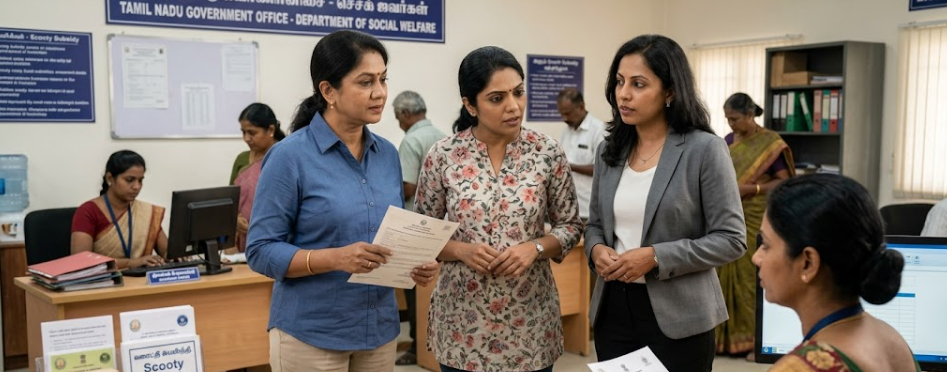
Mandatory Documents Required for Application
Missing documentation causes immediate rejection at the scrutiny phase. Consequently, compile certified photocopies of these core credentials beforehand:
- Proof of Identification: Aadhaar Card, Voter ID, or Smart Family Card.
- Residency Verification: Nativity or Residence Certificate issued by the local Tahsildar.
- Income Certificate: Recent family income slip from an authorized administrative officer.
- Driving Licence: Valid Two-Wheeler Driving Licence or LLR issued by the RTO.
- Educational Proof: School Transfer Certificate or Marksheet confirming 8th standard appearance.
- Employment Verification: Salary slip, employer certificate, e-Shram identity card, or self-employment declaration.
- Vehicle Quotation: Proforma invoice from an authorized vehicle dealership showing technical details.
- Bank Account Details: Passbook copy showing clear IFSC code and account details (must be Aadhaar-linked).
- Community Certificate: SC/ST certificate if claiming reserved quota benefits.
Step-by-Step Application Process
Follow this structured workflow to apply smoothly through official government channels:
Step 1: Obtain Application Form
   │
Step 2: Submit Completed File at Local Office
   │
Step 3: Verification & District Level Approval
   │
Step 4: Purchase Two-Wheeler & Submit Invoice
   │
Step 5: Direct Benefit Transfer (DBT) Grant Release
Phase 1: Form Acquisition and Submission
- Download: Visit the official state portal or pick up physical application forms directly from local Block Development Offices (BDO), Urban Local Body (ULB) offices, or Municipal Corporation centers.
- Data Entry: Complete all sections carefully using capital letters. Attach passport-size photographs along with self-attested document copies.
- Submission: Hand over the completed physical application to your local BDO or Municipal office. Obtain an official signed acknowledgment receipt containing your tracking number.
Phase 2: Verification and Subsidy Disbursement
- Field Inspection: Designated field officers verify employment details and residential claims.
- District Approval: Approved lists are vetted by the District Level Selection Committee (DLSC).
- Procurement: Upon receiving an official approval allotment letter, purchase the vehicle using personal savings or an approved bank loan.
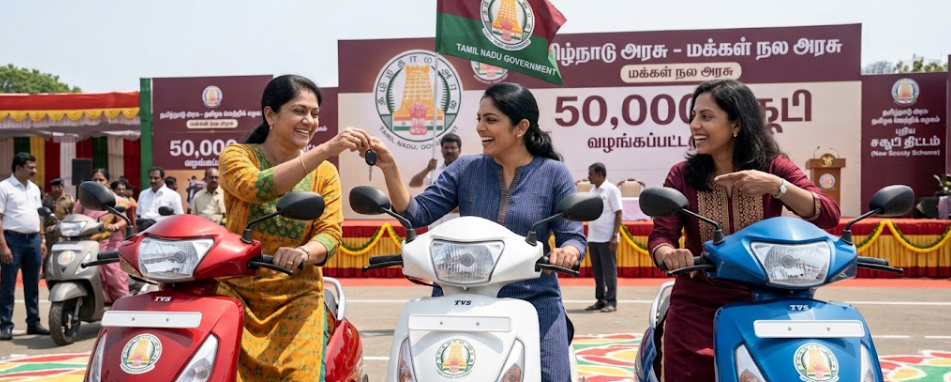
- Claim Settlement: Submit the vehicle’s original Registration Certificate (RC), insurance papers, and final invoice to the District Manager’s office. The 50% grant is credited directly into your Aadhaar-linked bank account via direct transfer.
Important Dates and Operational Schedule
State welfare schemes operate on financial year windows. Because deadlines vary based on annual budget releases, track local updates closely:
| Event Milestone | Estimated Schedule / Status |
| Notification Release | Usually announced at the start of the state financial year |
| Application Window | Open for 30 to 45 days following official public notification |
| Verification Phase | Completed within 2 to 4 weeks post-submission |
| Subsidy Credit Timeline | 30 to 60 days post-submission of Vehicle RC and final bills |
Official Links and Contact Portals
Always submit applications directly through authentic government sources. Never share private details or pay money to unverified third-party websites.
- Tamil Nadu Corporation for Development of Women: tamilnadumahalir.org
- National Portal for Central & State Schemes: myscheme.gov.in
- Puducherry Government Official Portal: py.gov.in
- Kerala Government Official Web Portal: kerala.gov.in
Summary Comparison Table
For a quick reference, use this copy-pasteable table summarizing the core features across popular women’s scooty assistance frameworks:
=================================================================================================================
SCHEME SUMMARY DATA SHEET
=================================================================================================================
Parameter                Amma Scheme (TN)                Pudhumai Penn (Puducherry)      She Scooter (Kerala)
-----------------------------------------------------------------------------------------------------------------
Primary Target           Working Women                   SC/ST Women & Students          Fisherwomen & SHG Members
Subsidy Percentage       50% of total cost               75% of vehicle cost             Up to 100% via grants
Maximum Cap              ₹25,000                         ₹1,000,000                      ₹1,000,000
Engine Limit             Up to 125cc Petrol / EV         Electric Scooter Only           Electric Scooter Only
Age Bracket              18 to 40 Years                  18 to 40 Years                  18 to 50 Years
Income Ceiling           ₹2,50,000 Per Year              ₹8,00,000 Per Year              Varies by SAF criteria
Application Mode         Offline (BDO / Municipal)       Departmental Submission         Nodal/Fisheries Office
=================================================================================================================
Frequently Asked Questions (FAQs)
1. Can I claim the 50% subsidy before purchasing the scooter?
No. State rules mandate that you purchase the vehicle first after receiving your initial selection letter. The subsidy is released as a reimbursement via Direct Benefit Transfer after you submit the vehicle’s RC book and purchase invoice.
2. Is an LLR (Learner’s Licence) sufficient, or do I need a permanent licence?
In most states, a valid Learner’s Licence (LLR) is acceptable at the time of initial application. However, you must present a valid permanent driving licence when submitting the final RC copy for reimbursement.
3. Can two women from the same family claim this subsidy?
No. The guidelines explicitly restrict the benefit to one working woman per household.
முடிவுரை
The 50% Scooty Subsidy Scheme remains a transformative welfare policy for working women seeking safe, reliable, and independent daily travel. By securing personal transport, women reduce commute times, expand their employment horizons, and achieve financial self-reliance. If you meet the age, income, and licensing requirements, gather your documents and visit your local Block Development Office or Municipal Corporation to inquire about active application cycles.
Disclaimer: This article is strictly for informational and educational purposes. Subsidy amounts, eligibility guidelines, and scheme availability vary by state and are subject to official government updates. Applicants should verify current scheme status and official guidelines directly at local government offices or official state portals before making financial decisions.