
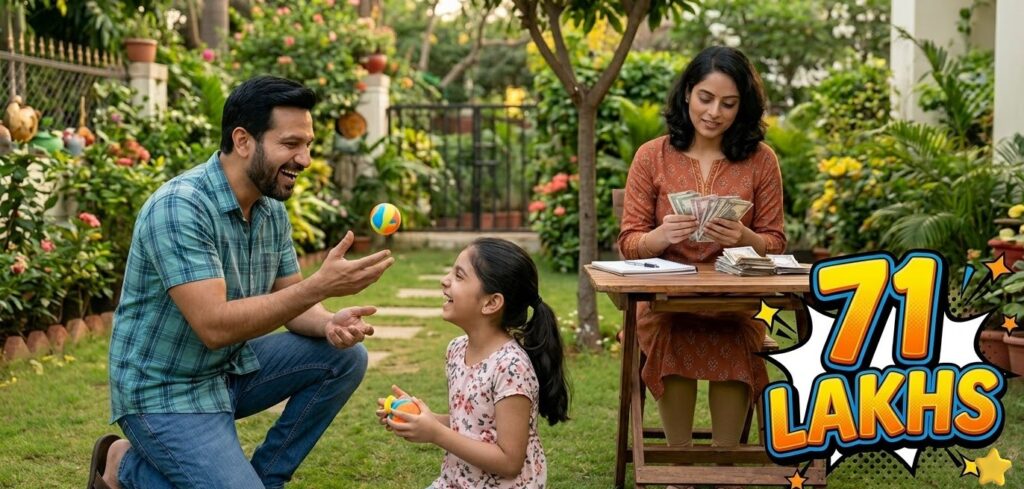
Every parent dreams of providing the best possible education and a secure future for their daughter. In India, the Sukanya Samriddhi Yojana (SSY) stands out as one of the most powerful financial tools to turn those dreams into reality. Launched under the “Beti Bachao, Beti Padhao” campaign, this government-backed savings scheme offers high interest rates, safety, and unmatched tax benefits.
As we move through 2026, the scheme has evolved with updated interest rates and streamlined digital processes. Whether you are a new parent or looking to optimize your savings, this 1000-word guide will walk you through everything you need to know, including a detailed calculation of what happens when you invest the maximum limit of ₹1.5 lakh per year.
What is Sukanya Samriddhi Yojana (SSY)?
The Sukanya Samriddhi Yojana is a small-deposit scheme specifically designed for the girl child. It is a long-term investment that ensures financial independence for girls when they reach adulthood, specifically for higher education and marriage. Since it is backed by the Government of India, your principal amount and the interest earned are 100% safe.
Key Highlights of SSY in 2026
| Feature | Details (as of March 2026) |
| Current Interest Rate | 8.2% per annum (Compounded Annually) |
| Minimum Deposit | ₹250 per financial year |
| Maximum Deposit | ₹1.5 Lakh per financial year |
| Investment Period | 15 years from the date of opening |
| Maturity Period | 21 years from the date of opening |
| Tax Status | EEE (Exempt-Exempt-Exempt) |
| Eligible Age | Girl child below 10 years of age |
Eligibility Criteria: Who Can Open an Account?
To keep the scheme focused on its core objective, the government has set specific eligibility rules:
- The Girl Child: The account must be opened in the name of a girl child who is a resident Indian.
- Age Limit: The girl must be below 10 years of age at the time of account opening.
- The Guardian: Only a natural parent or a legal guardian can open and operate the account on behalf of the minor girl.
- Number of Accounts: Generally, only two accounts are allowed per family (one for each girl). However, exceptions are made for triplets or if the second birth results in twins, provided the necessary legal affidavits are submitted.
The Power of 8.2% Interest: How Interest is Calculated
As of the quarter ending March 2026, the SSY interest rate is 8.2%. This is significantly higher than the Public Provident Fund (PPF) or standard Bank Fixed Deposits.
The “5th Day” Rule: To maximize your returns, it is crucial to understand how interest is calculated. The interest for the month is calculated on the lowest balance in the account between the close of the 5th day and the end of the month. Therefore, if you are making monthly deposits, always try to deposit the money on or before the 5th of every month.
How to Apply for Sukanya Samriddhi Yojana in 2026
Opening an SSY account is straightforward and can be done at any India Post Office or authorized commercial banks (such as SBI, ICICI, HDFC, Axis, etc.).
Step-by-Step Offline Process:
- Visit the Branch: Go to your nearest post office or authorized bank branch.
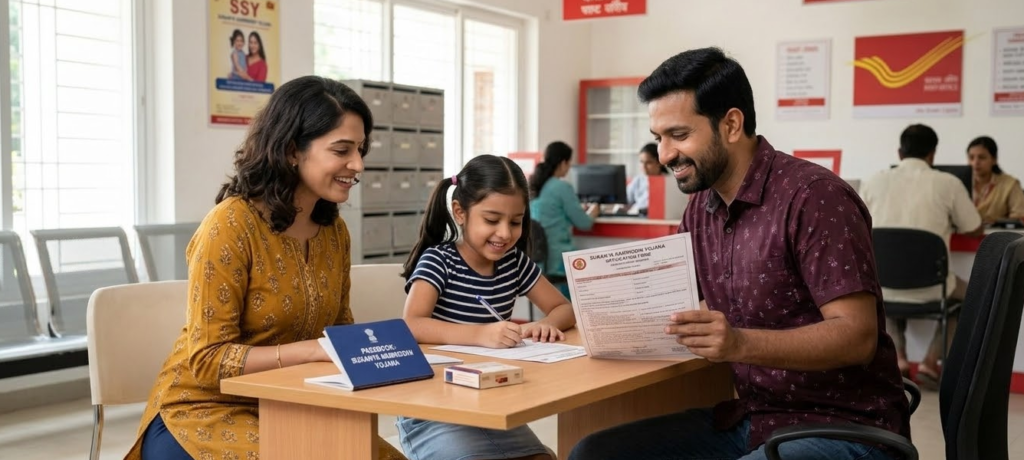
- Fill Form SSA-1: Obtain and fill out the Sukanya Samriddhi Account Opening Form.
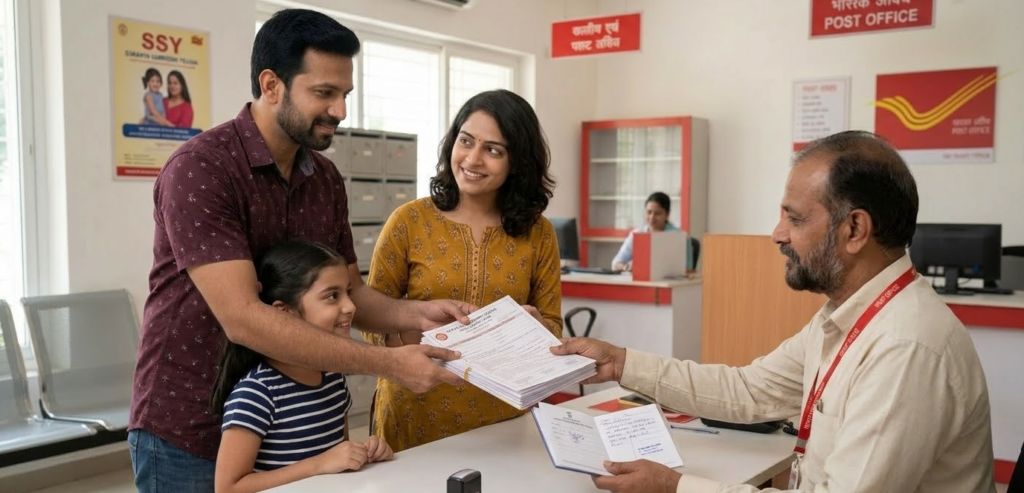
- Submit Documents: Attach the required KYC documents and the child’s birth certificate.
- Initial Deposit: Pay the initial deposit amount (minimum ₹250).
- Receive Passbook: Once processed, the bank/post office will issue a passbook containing the account opening date, child’s name, and address.
Can You Apply Online?
Currently, most banks allow you to transfer funds online into an existing SSY account through NetBanking or mobile apps. However, for the initial account opening, most institutions still require a physical visit to verify the original birth certificate of the girl child. Some private banks have started integrating digital applications where you can upload documents, but a one-time physical verification is often mandatory.
Documents Required for SSY Account Opening
Ensure you have the following documents ready to avoid delays:
- Birth Certificate: Mandatory certificate of the girl child issued by the municipal authority.
- Identity Proof: Aadhaar Card, PAN Card, or Passport of the parent/guardian.
- Address Proof: Ration card, electricity bill, or Aadhaar of the parent/guardian.
- Photographs: Recent passport-sized photos of both the child and the guardian
Real-Time Example: Investing ₹1.5 Lakh Per Year
Many investors want to know: “If I invest the maximum limit allowed, how much will my daughter actually get?”
Let’s look at a real-time scenario. Suppose you open an account for your newborn daughter in April 2026 and invest ₹1.5 Lakh every year (the maximum limit under Section 80C).
The Mathematical Breakdown:
- Annual Investment: ₹1,50,000
- Investment Duration: 15 Years
- Maturity Period: 21 Years (Interest continues to earn for 6 years after deposits stop)
- Assumed Interest Rate: 8.2% (constant for this example)
| Investment Phase | Calculation |
| Total Principal Invested | ₹1.5 Lakh × 15 years = ₹22,50,000 |
| Total Interest Earned | Approximately ₹49,32,119 |
| Final Maturity Amount | ₹71,82,119 |
The Result: By the time your daughter turns 21, she would receive approximately ₹71.82 Lakhs. This massive corpus is built primarily through the power of compounding. Since the interest earned in the early years itself starts earning interest, the growth accelerates dramatically in the final decade of the scheme
Triple Tax Benefits (The EEE Advantage)
One of the biggest reasons to choose SSY over other investments is its EEE (Exempt-Exempt-Exempt) status under the Indian Income Tax Act:
- Investment (Exempt): The amount you deposit (up to ₹1.5 lakh) is deductible from your taxable income under Section 80C.
- Interest (Exempt): The annual interest accrued is completely tax-free. You don’t have to pay a single rupee in tax on the 8.2% returns.
- Maturity (Exempt): The entire final amount (Principal + Interest) withdrawn after 21 years is also 100% tax-free.
| Feature | SSY | PPF | Fixed Deposit (FD) |
| Interest Rate | 8.2% (Highest) | 7.1% | 6.0% – 7.5% |
| Lock-in | 21 Years | 15 Years | Variable |
| Tax on Interest | Tax-Free | Tax-Free | Taxable |
| Risk | Zero (Govt Backed) | Zero (Govt Backed) | Low (Bank Backed) |
Withdrawal and Premature Closure Rules
The SSY is designed to be a long-term “lock-in” fund, but it does offer flexibility for major life events:
- Higher Education: Once the girl turns 18 OR completes the 10th standard, you can withdraw up to 50% of the previous year’s balance for her education expenses.
- Marriage: The account can be closed prematurely if the girl is getting married after reaching the age of 18.
- Special Circumstances: In the unfortunate event of the death of the account holder or life-threatening medical emergencies, the account can be closed with full interest.
Frequently Asked Questions (FAQs)
1. Can I open an SSY account for my adopted daughter? Yes, the scheme is available for both biological and legally adopted girl children.
2. What happens if I forget to deposit the minimum amount? If you don’t deposit at least ₹250 in a financial year, the account becomes “Defaulted.” You can regularize it by paying a small penalty of ₹50 per year plus the minimum deposit for the missed years.
3. Can I transfer the SSY account if I move to a different city? Yes, the SSY account is highly portable. You can transfer it from one post office to another or between banks anywhere in India for free (with proof of residence change)
Conclusion
The Sukanya Samriddhi Yojana is more than just a savings account; it is a gift of financial freedom for your daughter. With an 8.2% interest rate, sovereign guarantee, and “Triple Exempt” tax status, it remains the gold standard for girl-child savings in 2026. By starting early and disciplined investing—even if it’s not the full ₹1.5 lakh—you ensure that when she is ready to take on the world, her finances are the last thing she needs to worry about.
📢 Stay Updated on Government Schemes!
Do you want to receive the latest updates on Sukanya Samriddhi Yojana, scholarship alerts, and government subsidy news directly on your phone?
Interest
2 girl children how to ap[ply scheme
Interested
Hi
Ssy
The scheme providing financial assistance to girl children is highly beneficial.
my name neeraja devi qualification in 12 pass ia am protect from my family pls help …
Ssy schem
Ssy
Hi
I am housewife a baby
Ssy
logeshwarilogeshwari391@gmail.com
12th. 442
I sir my name Mahalakshmi I am protected my family I am +2 pass please consider my obligation kindly my request 🙏🙏😭🙏😭 please save my family 🙏.
my name neeraja devi qualification in 12 pass ia am protect from my family pls help..