

Finding out you are pregnant is one of the most transformative moments in life. In India, once that second line appears on the test kit, a whirlwind of joy, doctor visits, and family celebrations begins. However, amidst the excitement, there is a vital administrative step that every expectant mother must take: Registering for an RCH ID.
While it might sound like “just another government formality,” the RCH ID is actually your golden ticket to high-quality maternal healthcare, financial incentives, and a seamless vaccination journey for your child. In this era of Digital India, the government has made it incredibly simple to secure this ID, whether you prefer the traditional offline route or the convenience of an online portal.

What exactly is an RCH ID?
The Reproductive and Child Health (RCH) ID is a unique 12-digit identification number issued by the Ministry of Health and Family Welfare (MoHFW), Government of India. It was introduced under the RCH Portal, which evolved from the earlier Mother and Child Tracking System (MCTS).
Think of it as a digital health passport. Once a woman confirms her pregnancy and registers, this ID tracks her health throughout the gestation period, delivery, and subsequently monitors the child’s immunization and growth until the age of five. It ensures that no mother or child falls through the cracks of the healthcare system.
Why is the RCH ID So Important?
The primary goal of the RCH ID is to reduce the Maternal Mortality Ratio (MMR) and the Infant Mortality Rate (IMR) by providing timely interventions. Here is why it is indispensable for you:
1. Access to Antenatal Care (ANC)
With an RCH ID, you are automatically enrolled in a system that schedules your checkups. This includes the four mandatory ANC visits, blood tests, and ultrasound scans required to monitor the baby’s development.
2. Direct Benefit Transfer (DBT)
The Indian government offers several financial schemes to support pregnant women, particularly those from lower-income backgrounds. Schemes like Pradhan Mantri Matru Vandana Yojana (PMMVY) and Janani Suraksha Yojana (JSY) require a valid RCH ID for the funds to be transferred directly to your bank account.
3. Tracking Immunization
Post-delivery, the RCH ID transitions to the child. It helps health workers keep track of the National Immunization Schedule, sending you reminders for essential vaccines like Polio, BCG, and Hepatitis B.
4. Emergency Support
In case of complications during labor, having your RCH ID allows doctors at any government hospital to quickly access your medical history and previous scan reports stored in the central database.
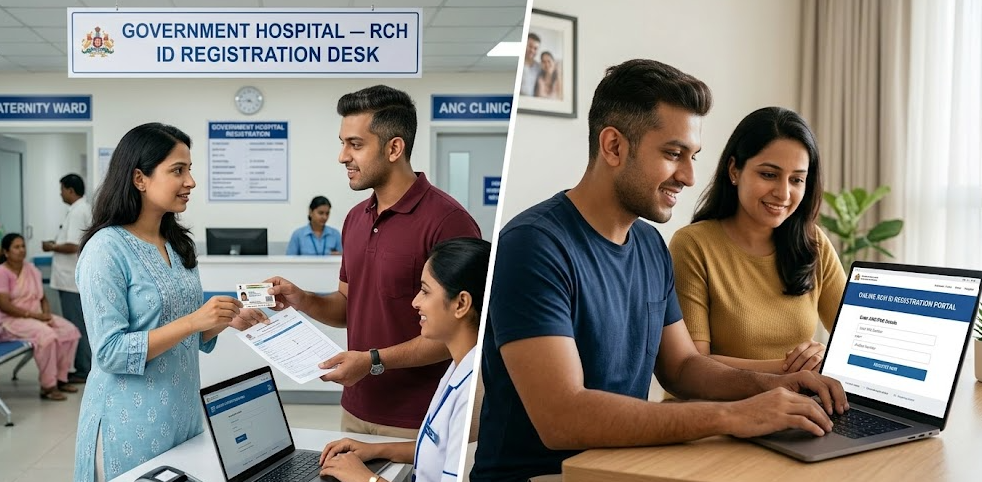
How to Register for RCH ID: Offline vs. Online
The government provides two primary methods to register. Choose the one that best suits your location and accessibility.
Method 1: The Offline Process (The Traditional Way)
This remains the most popular method, especially in rural and semi-urban areas. It relies on a strong network of frontline health workers.
- Contact your ASHA or ANM: Every locality in India is assigned an ASHA (Accredited Social Health Activist) or an ANM (Auxiliary Nurse Midwife). As soon as you confirm your pregnancy, notify them.
- Visit the Nearest Health Center: You can go to your local Primary Health Center (PHC), Community Health Center (CHC), or a government maternity hospital.
- The MCP Card: Upon registration, the health worker will provide you with a Mother and Child Protection (MCP) Card. This physical card will have your 12-digit RCH ID handwritten or printed on it.
- Data Entry: The ANM will take your details and manually enter them into the ANMOL (ANM Online) tablet/app, which then syncs with the national RCH portal.
Method 2: The Online Process (Self-Registration)
For tech-savvy urban residents or those who want to initiate the process from home, the government has introduced self-registration features on specific state and central portals.
- Visit the Official Portal: Go to the RCH Official Website.
- Navigate to “Self Registration”: Look for the “Citizen Section” or “Self Registration” tab (availability may vary based on the current state-specific portal updates).
- Fill the Form: You will need to enter your Name, Age, Address, Mobile Number, and the Date of your Last Menstrual Period (LMP).
- OTP Verification: A one-time password will be sent to your mobile number to verify your identity.
- Generation of ID: Once submitted, a temporary ID is generated, which is later verified by a local health official to become a permanent RCH ID
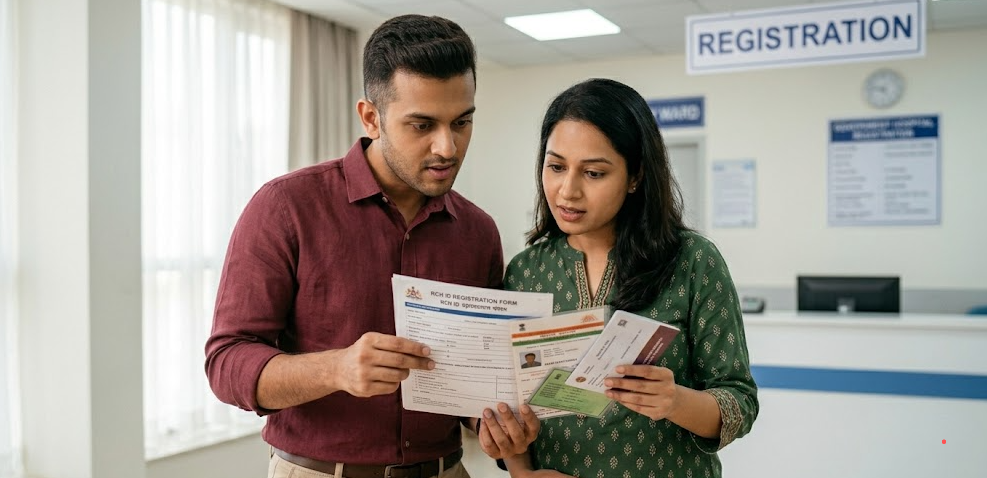
Required Documents for Registration
To ensure a smooth registration process, keep the following documents ready (both originals and photocopies):
| Document Type | Purpose |
| Aadhaar Card | Primary identity and address proof. |
| Bank Passbook | Essential for receiving PMMVY or JSY cash incentives. |
| Mobile Number | To receive SMS alerts for checkups and vaccinations. |
| Voter ID/Ration Card | Secondary proof of residence if Aadhaar is unavailable. |
Understanding the RCH Portal Ecosystem
The RCH portal is not just a database; it’s a comprehensive management tool. It includes several modules that work in tandem:
- Location Master: Maps every village and hamlet to a specific health facility.
- Health Provider Ledger: Tracks the performance and reach of ANMs and ASHAs.
- Workplan Generation: Every month, the portal generates a “Workplan” for health workers, telling them exactly which mother in their area is due for a checkup or which child needs a vaccine.
Linking RCH ID with Government Schemes
One of the biggest advantages of the RCH ID is its integration with financial welfare programs.
Pradhan Mantri Matru Vandana Yojana (PMMVY)
Under this scheme, pregnant women receive ₹5,000 in three installments (or a consolidated amount as per the latest 2.0 guidelines) for their first living child. The RCH ID serves as the primary verification to ensure the beneficiary is indeed receiving prenatal care.
Janani Suraksha Yojana (JSY)
This is a safe motherhood intervention under the National Health Mission. It provides a cash incentive to mothers who opt for institutional delivery (giving birth in a hospital rather than at home). The RCH ID tracks the delivery location to facilitate this payment.

What to Do After Getting Your RCH ID?
Once you have your ID, your job isn’t finished. To get the maximum benefit, follow these steps:
- Keep your MCP Card Safe: This card is your physical record. Bring it to every doctor’s visit, whether you go to a government or private clinic.
- Update your Records: If you change your mobile number or move to a different city, inform your ANM so your records can be transferred to the new location’s database.
- Check your SMS Alerts: The RCH system sends automated SMS reminders for ANC visits. Do not ignore these; they are timed according to your LMP to ensure optimal fetal health.
- Verify your Data: You can visit the RCH portal and use the “Know your RCH ID” or “Track Beneficiary” feature to ensure your details (like immunization dates) are being updated correctly by the health workers.
Frequently Asked Questions (FAQs)
Q: Can I get an RCH ID if I am going to a private hospital for delivery?
A: Yes! Even if you prefer a private hospital, you should register for an RCH ID through your local ASHA or the online portal. This ensures your child is recorded in the national immunization database.
Q: Is the RCH ID the same as the ABHA ID?
A: No. The ABHA (Ayushman Bharat Health Account) is a general health ID for all citizens. The RCH ID is specifically for maternal and child health tracking. However, the government is currently working on linking the two for a unified health record.
Q: What if I lose my RCH ID?
A: You can retrieve it from the RCH portal using your registered mobile number or by contacting your local ANM, who can find your details in her register.
Conclusion: A Step Toward a Healthier India
The RCH ID is more than just a sequence of twelve numbers; it is a shield of protection for both the mother and the newborn. By streamlining the registration process through both offline and online channels, the Government of India has ensured that healthcare is inclusive and data-driven.
If you or someone you know is pregnant, don’t delay. Reach out to your local health worker or visit the RCH portal today. It is the first and most important gift you can give your child—the gift of guaranteed healthcare and a monitored, safe start to life.
Stay Informed with WiseIndia > Navigating government schemes and health updates can be overwhelming. To receive real-time alerts on pregnancy schemes, RCH portal updates, and financial benefits directly on your phone, join the official WiseIndia WhatsApp Channel.
This post will assist the internet viewers for building up new weblog or even a weblog from start
to end.