
For millions of households across India, the Ration Card is not merely a piece of paper; it is a vital identity document and a gateway to food security. While most people possess “Rice Ration Cards” that provide access to essential grains at subsidized prices, a significant number still hold “Sugar-only” cards. These were often originally selected by families who did not intend to draw rice or wheat quotas.
However, as economic needs shift and family sizes grow, many now find that converting their existing Sugar Card to a comprehensive Rice Card is a logical step toward broader food security. Thankfully, under the Digital India initiative and standardized Public Distribution System (PDS) reforms, this conversion process has become more accessible than ever before.
This article provides a detailed roadmap for converting your Indian Sugar Ration Card to a Rice Ration Card, covering both online and offline methods, comparing them, listing essential documents, and providing official government links.

Understanding the Need: Why Convert Your Ration Card Type?
Before diving into the “how,” it’s crucial to understand what you gain by making the switch. In most Indian states, Ration Cards are categorized based on entitlements.
The Limitation of a Sugar Card
A “Sugar-only” card (often color-coded white or blue in different regions) limits your entitlements primarily to sugar. Depending on the state, this might mean a maximum quota of 2kg to 5kg of sugar per family per month, but zero allowance for subsidized rice or wheat.
The Benefit of a Rice Card
By converting to a “Rice Ration Card” (which often corresponds to the “Priority Household” (PHH) or “Antyodaya Anna Yojana” (AAY) category depending on income), your household unlocks access to a much wider array of essential commodities:
- Subsidized Rice: The staple entitlement.
- Subsidized Wheat: Available in most regions.
- Subsidized Pulses & Cooking Oil: (In certain states like Tamil Nadu or West Bengal).
- Subsidized Kerosene: Depending on state policy and cooking fuel status.
Essentially, a Rice Card provides a versatile safety net for your family’s nutritional needs.
Comparison: Online vs. Offline Method
Many states now offer both methods. Here is a comparison to help you choose the right path.
| Feature | Online Method | Offline Method |
| Convenience | High. Apply from anywhere. | Low. Requires travel to offices. |
| Time Spent | Low. Standard forms can be filled quickly. | High. May require multiple visits. |
| Technical Skill | Needed. (Internet browsing, OTP usage, uploading documents). | Not needed. (Paper forms are filled manually). |
| Tracking | Instant tracking using a reference number. | Tracking can be slow or require visits. |
| Verification | Digital documents reviewed first; physical verification might follow. | Physical documents and field verification are default. |
| Approval Speed | Generally faster. | Can be slower due to physical paperwork. |
Recommendation: If you have access to a smartphone or computer and are comfortable with online portals, the Online Method is superior. It is faster, transparent, and less time-consuming.

How to Convert Sugar Card to Rice Card: Online Method
Since PDS is managed primarily by state governments, the exact look of the portal varies. However, the digitized workflow is generally standardized. We have used the Tamil Nadu portal (TNEPDS) as a representative example, as it has one of the largest numbers of “Sugar Card” conversions.
Standard Step-by-Step Procedure:
Step 1: Access the State PDS Portal
Go to the official Food and Consumer Protection Department website for your specific state. (See the list of official links in Section 5).
Step 2: Beneficiary Login (OTP-based)
On the homepage, look for an option like “Beneficiary Login” or “Card Holder Login.”
- Enter the registered mobile number associated with your current Ration Card.
- Click “Send OTP.”
- Enter the One-Time Password received on your phone to access your dashboard.
Step 3: Locate “Change of Card Type” / “Mutation”
Within your dashboard, search for a section related to making changes or amendments. It might be listed under categories like:
- “Card Mutation”
- “Correct Details”
- “Change Category”
- “Amendment Request”
Step 4: Fill the Form and State Reason
You will be directed to a digital form. Your current details will typically be pre-filled.
- Look for the dropdown menu labeled “New Card Type” or “Change To Category.”
- Select the appropriate Rice Card option (e.g., PHH or APL/BPL Rice Card as per your state’s nomenclature).
- In the “Reason for Change” box, clearly state your reasons (e.g., “Need broader food grains for family consumption,” or “Family size increased”).
Step 5: Upload Required Documents (Scanned Copies)
You will need to upload digital copies of essential documents. Ensure they are under the specified size limit (e.g., 200KB) and in the correct format (JPEG/PDF).
- Original Sugar Ration Card (First and last page).
- Aadhar Cards of all family members.
- Proof of Income or a Self-Declaration form (verifying you meet the income criteria for the new card).
Step 6: Submit and Track
Click submit. You will instantly receive a reference number. Note this down carefully. You can use it later on the same portal under the “Track Application Status” link.
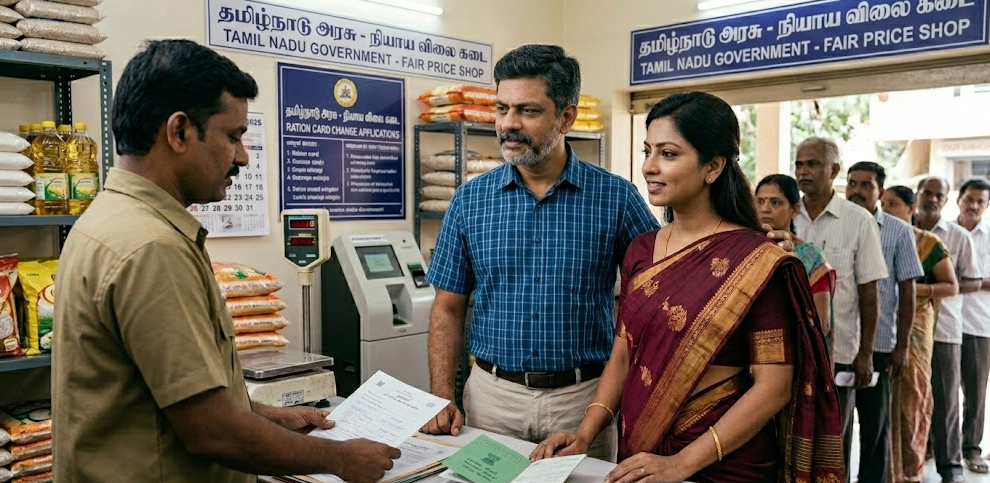
How to Convert Sugar Card to Rice Card: Offline Method
This method is vital for those in rural areas with limited internet connectivity or for citizens who prefer standard paper-based bureaucratic processes.
Standard Step-by-Step Procedure:
Step 1: Visit the Taluk or District Supply Office
You need to physically visit the Taluk Supply Office (TSO), District Supply Office (DSO), or your nearest government-authorized Common Service Center (CSC), such as the e-Seva centers.
Step 2: Request the Correct Application Form
Request the specific application form for “Ration Card Category Change” or “Card Mutation.” This form is often numbered differently from the new card application form.
Step 3: Complete the Form
Fill out the form manually. Ensure all details—such as Aadhar numbers, names, and address—match your supporting documents exactly.
- Specify clearly that you wish to change your Sugar Card to a Rice Card.
Step 4: Attach Physical Proofs
Attach self-attested photocopies of all necessary documents. (Section 6 has the checklist).
Step 5: Submit the Physical Card
In some regions, you may be required to submit your original physical “Sugar Card” alongside the application. An acknowledgement receipt will be issued to you.
Step 6: Wait for Field Verification
Once submitted, a Food Supply Officer (FSO) will typically conduct a field verification visit to your residence to verify your family composition and economic status before granting approval.
Essential Documents Checklist
Whether applying online or offline, keep these documents ready. Self-attestation is required for offline submission.
- Original or Aadhar-seeded Sugar Ration Card: The document being converted.
- Aadhar Cards: Mandatory for all family members listed on the card.
- Proof of Residence (any one):
- Electricity Bill
- Voter ID Card
- Passport
- Property Tax Receipt
- Rental Agreement
- Proof of Income: Salary slips, Income Tax returns, or an affidavit of income. This is critical as Rice Cards are income-dependent.
- Recent Passport-sized Photographs: Of the Head of the Household.
- Self-Declaration form: (Usually a standardized state form downloadable from the portal) confirming you are not holding duplicate cards and meet income criteria.

List of Official State Government PDS Portals
The single most important step is visiting the official government link. Avoid third-party agents or unofficial websites.
Here are the official links to the major state Food and Civil Supplies departments:
| State / UT | Official PDS Portal Link |
| National Food Security Portal (Main Hub) | https://nfsa.gov.in/ |
| Andhra Pradesh (AePDS) | https://aepos.ap.gov.in/ |
| Kerala (ePDS) | https://epds.kerala.gov.in/ |
| Maharashtra (MahaFood) | http://mahafood.gov.in/ |
| Punjab (EPOS) | https://epos.punjab.gov.in/ |
| Rajasthan (Food Portal) | https://food.rajasthan.gov.in/ |
| Tamil Nadu (TNEPDS) | https://www.tnpds.gov.in/ |
| Uttar Pradesh (FCS Portal) | https://fcs.up.gov.in/ |
| West Bengal (Food Dept) | https://food.wb.gov.in/ |
Conclusion: Securing Your Family’s Nutrition
Converting your Sugar Ration Card to a Rice Ration Card is a proactive decision that significantly enhances your family’s access to diversified food security. While the workflow varies slightly by state, the fundamental requirement remains high transparency regarding family members (via Aadhaar) and economic eligibility.
Whether you choose the speedy online route or the reassuringly manual offline path, patience is key. The verification process, though digitized, involves human review and can take from 15 to 45 days depending on the region. Utilize the tracking numbers provided to monitor the process and ensure your digital application is approved without being marked for correction.
By following this guide precisely, you can navigate the Indian PDS bureaucracy effectively and secure the broad nutritional benefits your family deserves.
📲 Never Miss a Ration Card Update Again!
Government rules and PDS links change frequently. Stay ahead of the curve by joining the Official WiseIndia WhatsApp Channel. Get real-time alerts on Ration Card deadlines, new government schemes, and simplified guides delivered straight to your phone.