

Finding money you didn’t know you had feels like a small miracle. Whether it’s a crumpled 500-rupee note in a winter jacket or a forgotten ₹50 in an old pair of jeans, that rush of “found money” is universal. But imagine if that amount wasn’t just pocket change. Imagine if it was a life-changing sum—thousands or even lakhs of rupees—sitting in a silent bank account, waiting for its rightful owner to come home.
In India today, this isn’t just a fantasy. As of early 2026, the Reserve Bank of India (RBI) reports a staggering reality: over ₹62,000 crore (and by some estimates, closer to ₹78,000 crore) is lying unclaimed in various banks across the country. This mountain of money belongs to people like you, your parents, or perhaps a grandparent who opened an account decades ago and simply lost track.
This article is your guide to navigating UDGAM, understanding the world of unclaimed funds in India, and most importantly, the step-by-step process to bring that money back where it belongs.
What Exactly Are “Unclaimed Funds”?
Life happens. People move cities, change jobs, or unfortunately, pass away without documenting every single financial detail for their heirs. When a bank account remains inactive for 10 years—meaning no deposits or withdrawals have been made—the money is classified as an “unclaimed deposit.”
These funds don’t disappear into the bank’s profits. Instead, they are transferred to the Depositor Education and Awareness (DEA) Fund, maintained by the RBI. Whether it’s a Savings Account balance, a matured Fixed Deposit (FD) that was never renewed, or a forgotten Recurring Deposit, the money remains yours legally. You just need to prove it.
Enter UDGAM: The Digital Treasure Map
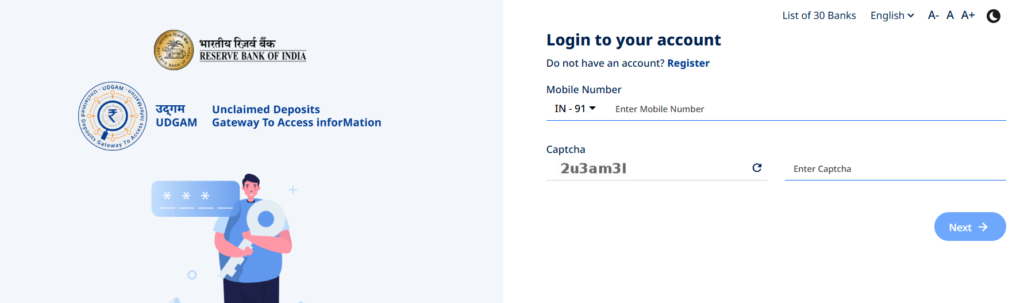
For years, finding unclaimed money was a Herculean task. You had to visit individual bank websites, scan through massive PDF files, and hope to spot a familiar name. Recognizing this struggle, the RBI launched UDGAM (Unclaimed Deposits – Gateway to Access Information).
UDGAM is a centralized portal that acts as a single window. Instead of visiting 30 different bank websites, you can search for forgotten accounts across multiple banks in one go. It’s designed with a “human-first” approach, making it accessible even to those who aren’t tech-savvy.
How to Search for Your Money on UDGAM
If you suspect there’s a forgotten account in your name or a deceased relative’s name, here is how you start:
- Registration: Visit the official UDGAM portal. You’ll need to register with your mobile number and name. A quick OTP verification, and you’re in.
- The Search Criteria: You don’t need an account number to start. You can search using:
- The name of the account holder.
- The name of the bank (you can select “All” to be thorough).
- One identification document: PAN card, Voter ID, Passport, or Driving License.
- The Result: If a match is found, the portal will display the name, address, and the bank where the funds are held. It will also provide a UDRN (Unclaimed Deposit Reference Number)—this is your golden ticket for the next step
The Human Side: The Claim Process
Finding the money on a screen is exciting, but the real work—the “claim”—happens offline. Why? Because banks must ensure the money goes to the right person.
Scenario A: Claiming Your Own Money
If you’ve found an old account of your own, the process is straightforward:
- Visit the Branch: Go to the nearest branch of the bank identified.
- KYC is Key: Bring your original ID proofs (Aadhaar, PAN) and a recent photograph.
- The Claim Form: Fill out the Unclaimed Deposit Claim Form. If the bank verifies your identity, they will reactivate the account or settle the amount directly into your active savings account.
Scenario B: Claiming as a Legal Heir or Nominee
This is the most common scenario, often involving children searching for their late parents’ savings.
- Documentation: You will need the Death Certificate of the original account holder.
- Proof of Relationship: Documents showing you are the legal heir (Succession Certificate, Will, or a Letter of Administration).
- The Process: The bank will conduct “due diligence.” They aren’t trying to withhold your money; they are protecting the legacy of the deceased. It might take a few weeks, but once the paperwork is in order, the funds are released.
Beyond Banks: The IEPF and Insurance Proceeds
While UDGAM covers bank deposits, billions more are hidden in other financial corners.
1. Unclaimed Shares and Dividends (IEPF)
If you held shares in a company and didn’t claim dividends for seven consecutive years, those shares and the dividend money are moved to the Investor Education and Protection Fund (IEPF).
- How to claim: Visit the IEPF website (iepf.gov.in). You will need to file an e-Form IEPF-5. This process is slightly more technical and involves sending physical documents to the company’s “Nodal Officer.”
2. Unclaimed Insurance (Bima Bharosa)
Often, life insurance policies mature, or claims are made, but the money never reaches the nominee due to an old address or a closed bank account.
- How to claim: Most major insurers like LIC have a dedicated “Unclaimed Amount” tool on their websites. You can search using the policyholder’s name and date of birth.
Why You Should Do This Today
We often think of financial planning as looking forward—investing for the future. But sometimes, looking backward is just as valuable.
There is a deep emotional value in reclaiming these funds. For many families, finding an old FD or a forgotten insurance payout provides a sense of closure. It’s a final gift from a loved one, a reminder of their hard work and their desire to provide for their family.
A Pro-Tip: Don’t just search for yourself. Sit down with your parents or elderly relatives this weekend. Ask them about their old bank accounts. Many people from the “passbook era” may have forgotten about an account they opened in a different city forty years ago. A ten-minute search on UDGAM could lead to a significant family windfall.
Closing Thoughts: Your Money, Your Right
The Indian government and the RBI have made massive strides with the “100 Days 100 Pays” campaign and the UDGAM portal to ensure this “lost” wealth is reunited with its owners. But the final step depends on you.
The money sitting in the DEA fund is not a donation; it is your wealth. In an era of rising costs and economic shifts, reclaiming what is rightfully yours is the smartest financial move you can make this year. Take an hour this weekend, log into UDGAM, and see if there’s a “miracle” waiting for you.