
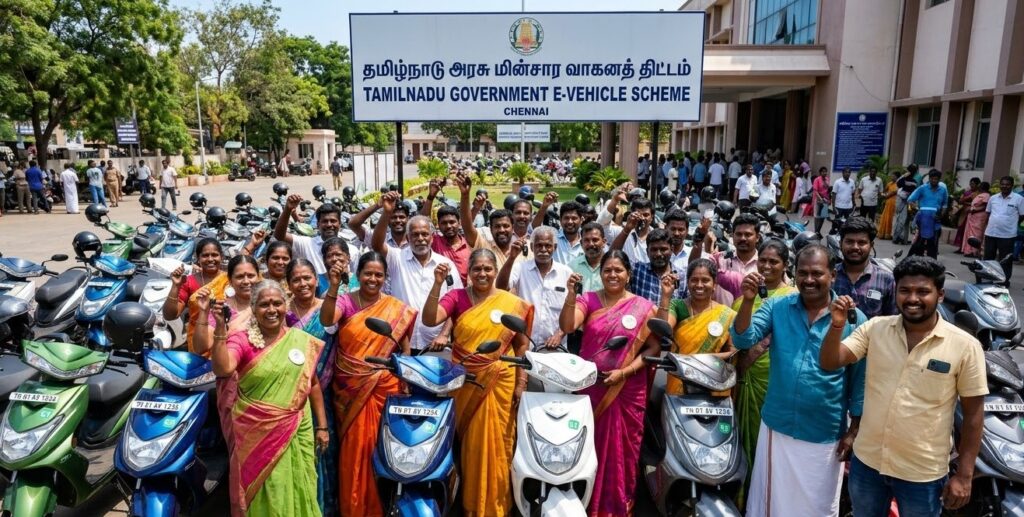
The landscape of transportation in Tamil Nadu is shifting rapidly. As you traverse the bustling streets of cities like Dindigul, Chennai, or Madurai, the quiet hum of electric scooters is becoming as common as the roar of petrol engines. This transition isn’t just about going green; it’s about financial survival. With rising fuel prices, the cost of daily commuting has become a significant burden for the backbone of our modern economy: the gig workers and delivery partners.
To support this vital workforce, the Government of Tamil Nadu recently announced a landmark initiative in the 2025-26 Budget: a direct ₹20,000 subsidy for the purchase of new electric scooters. This scheme is a game-changer for those working in the unorganized sector, offering a bridge to more sustainable and affordable livelihoods.
In this guide, we will break down everything you need to know about the Tamil Nadu E-Scooter Subsidy, from eligibility criteria to the step-by-step application process.

What is the Tamil Nadu ₹20,000 E-Scooter Subsidy?
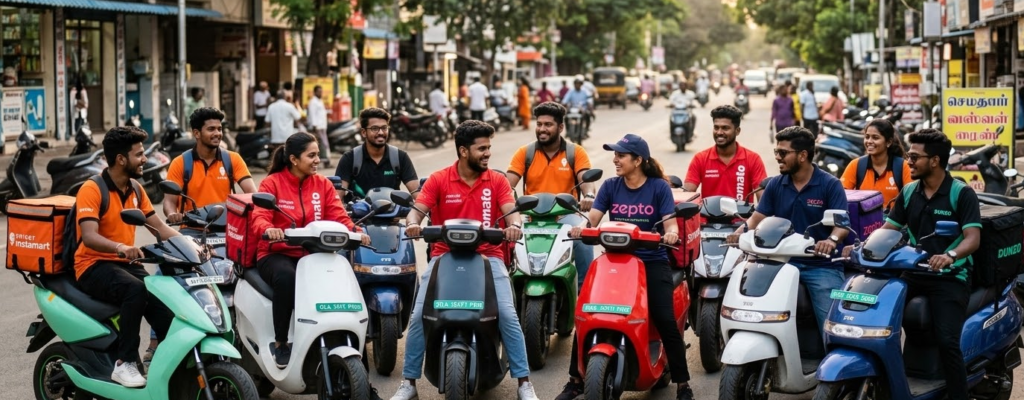
Announced by Finance Minister Thangam Thennarasu, this scheme is specifically designed to empower platform-based gig workers—those who work for delivery and ride-hailing apps like Swiggy, Zomato, Amazon, Zepto, and Dunzo.
The government has initially allocated ₹4 crore for this project, intending to provide a ₹20,000 cash subsidy to the first 2,000 registered workers who apply. This is a direct benefit that significantly lowers the upfront cost of shifting from a petrol bike to an electric one.
Beyond the Subsidy: A Safety Net
The government isn’t just helping with the purchase. Recognizing the risks gig workers face, the state has also introduced:
- Group Insurance: Coverage of up to ₹5 lakh for accidental death and ₹2.5 lakh for permanent disability.
- Welfare Board Support: Integration with the Tamil Nadu Platform-Based Gig Workers Welfare Board to ensure long-term social security.
Who is Eligible for the Scheme?
To ensure the benefit reaches those who need it most, the Tamil Nadu government has set specific eligibility standards. To qualify for the ₹20,000 subsidy, an applicant must:
- Be a Resident of Tamil Nadu: The scheme is strictly for permanent residents of the state.
- Be a Registered Member of the Welfare Board: You must be registered with the Tamil Nadu Unorganized Workers Welfare Board (TNUWWB). Specifically, you should be enrolled under the “Platform-Based Gig Workers” category.
- Active Work Status: You must be actively engaged in gig work (delivery, courier, or ride-sharing) via an online platform.
- Valid Documentation: Applicants must possess a valid Indian Driving License (DL) for two-wheelers.

Documents Required for Application
Preparation is key to a successful application. Before you head to the portal, ensure you have digital copies of the following documents ready:
| Document | Purpose |
| Aadhaar Card | Identity and residency proof. |
| Ration Card | Proof of address in Tamil Nadu. |
| Welfare Board ID | Your unique registration number from TNUWWB. |
| Driving License | Proof of eligibility to operate a vehicle. |
| Employment Proof | ID card or certificate from the delivery platform (e.g., Swiggy/Zomato). |
| Bank Passbook | The front page showing your account number and IFSC code for the subsidy transfer. |
| Vehicle Quotation | A formal quote for the e-scooter from an authorized dealer. |
How to Apply: Step-by-Step Guide
The application process is handled primarily through the official portal of the Tamil Nadu Unorganized Workers Welfare Board. Follow these steps to submit your claim:
Step 1: Register with the Welfare Board (If not already a member)
If you haven’t registered as a gig worker yet, this is your first priority.
- Visit the Official TNUWWB Portal.
- Click on “New Registration” and select the Gig Workers category.
- Fill in your personal details, upload your Aadhaar and work ID, and submit.
- Once approved, you will receive a registration number.
Step 2: Access the Subsidy Application
- Go to the TNUWWB Claims Login.
- Log in using your registration number and password/OTP.
- Look for the link titled “Click here to apply for eScooter Subsidy for the Platform-based Gig Workers.”
Step 3: Fill out the Form
- Enter the details of the e-scooter you plan to buy.
- Upload the scanned copies of your DL, bank passbook, and the dealer’s quotation.
- Submit the application and save the Application ID for tracking.
Step 4: Verification and Approval
The District Labour Office will verify your documents. In some cases, officials may contact you or your employer for verification. Once approved, the subsidy amount of ₹20,000 will be credited directly to your bank account via Direct Benefit Transfer (DBT).
Can You Stack This with Central Government Subsidies?
Yes! This is where the deal gets even better. The Tamil Nadu state subsidy of ₹20,000 works in addition to the Central Government’s PM E-DRIVE scheme (formerly FAME).
- PM E-DRIVE Benefit: This central scheme typically offers an upfront discount of roughly ₹5,000 to ₹10,000 (depending on the battery capacity) which is deducted by the dealer at the time of purchase.
- Combined Savings: Between the state and central benefits, a gig worker can effectively save nearly ₹30,000 on a new e-scooter.
The “Invisible” Benefit: Road Tax & Registration
While the ₹20,000 cash is the highlight, Tamil Nadu offers another massive financial perk. The state government has extended the 100% Road Tax Exemption for all electric vehicles until December 31, 2027.
Typically, road tax for a two-wheeler can range from ₹5,000 to ₹10,000 depending on the vehicle’s price. By going electric, you save this amount entirely at the RTO, making the “on-road” price of an EV almost the same as its “ex-showroom” price.
Why This Matters for the Common Man
For an entrepreneur or a delivery partner, an electric scooter isn’t just a vehicle—it’s a tool for profit. A typical petrol scooter costs about ₹2.5 to ₹3.0 per kilometer to run. An electric scooter, however, costs roughly ₹0.25 to ₹0.40 per kilometer.
If a gig worker covers 80 km a day, they save nearly ₹150 to ₹200 daily. Over a year, that’s over ₹50,000 in savings—more than enough to pay off the vehicle’s cost in less than two years. With the government’s ₹20,000 boost, the payback period becomes even shorter.
Final Thoughts
The Tamil Nadu government’s e-scooter subsidy is a forward-thinking policy that balances environmental goals with social welfare. If you are a gig worker in Tamil Nadu, this is the perfect time to make the switch. Not only do you get a direct financial incentive, but you also gain the peace of mind that comes with insurance and reduced operating costs.
Don’t wait too long—remember that the initial phase is limited to the first 2,000 applicants. Head over to the TNUWWB portal today and secure your spot in the green revolution!
E scooter
Please 🙏 help me
Schootrr
Scooter
E Scooter
E bike
I need electric scooter
I want ebike
E bike subcde wanted
E scooter.
Scooter
Electric scooty
I need a scooter for office going through my home
I want to buy e scooter in tamil nadu government plan
E scooter
You will give this e bike very helpful to me
Hello
Electric scooty
Thanks for your e bike sir
Scooter
This article is very helpful. Thank you for sharing this information.learned useful information from this page. It is easy to understand.Thank you for explaining Tamil Nadu e-services clearly. This helped me a lot.
Zopto
Thank for a ev bike
This article is very useful and informative. Thank you for sharing this helpful content.
Scooter
I need a electric scooter subsidy
I need this e bike subsidy
I need this e bike scooter subsidy
E. Scooty
I am scooty
Scooty
நான் மின்சார வன்டிவாங்கவிரும்புகிறென்